Ammo Brand Ballistic Calculators Compared: Federal, Remington, Winchester & More
Compare Federal, Remington, Winchester, Nosler, Barnes, Sierra & Norma ballistic calculators. Find the right tool for your ammo, then upgrade to Atlas.
- Federal, Remington and Winchester calculators — best for a quick factory drop chart for their own loads. Web-only, fixed catalog, no truing.
- Nosler, Barnes and Sierra calculators — best for a quick look at their bullets, including handloads. Still single-brand, with no field tools.
- Atlas Ballistics — best if you want one app for every brand, trued to your rifle, working offline.
Bottom line: brand calculators are fine for a first estimate. To actually hit at distance you need a solution trued to your rifle, and they can't do that.
Feature-by-feature comparison
| Feature | Federal / Rem / Win | Nosler / Sierra | Atlas |
|---|---|---|---|
| Ballistic model | |||
| Bullet library | Own factory loads | Own bullets | 935 loads & bullets, any brand |
| Drag model | Mostly G1 | G1, G7 | G1, G7 + drag factor tuning |
| Spin drift | |||
| Coriolis | |||
| In the field | |||
| Truing to your rifle | MV truing (Pro) | ||
| Works offline | |||
| Stage cards / DOPE export | yes (Pro) | ||
| Shot logging | |||
| Access | |||
| Platform | Web | Web | iOS, Android |
| Cost | Free | Free | Free, Pro $5.99/mo |
Capability coverage
Share of the 4 long-range capabilities in the table above that each tool supports.
Which one should you pick?
Federal / Rem / Win
Choose it if: you shoot their factory ammo and want a rough drop chart.
- Free
- Matches their published loads
- Single brand
- No truing, needs signal
Nosler / Sierra
Choose it if: you handload their bullets and want a quick estimate.
- Free
- Covers component bullets
- Single brand
- No field tools
Atlas
Choose it if: you shoot more than one brand and want to hit at distance.
- 935 loads and bullets from any brand, plus your own
- Spin drift, Coriolis and aero jump built in
- Works offline, with stage cards and a shot log
- Requires internet only for live weather and AI box scanner
- Truing, stage cards and shots past 300 yd need Pro
What you get that the others don't
True your rifle in minutes
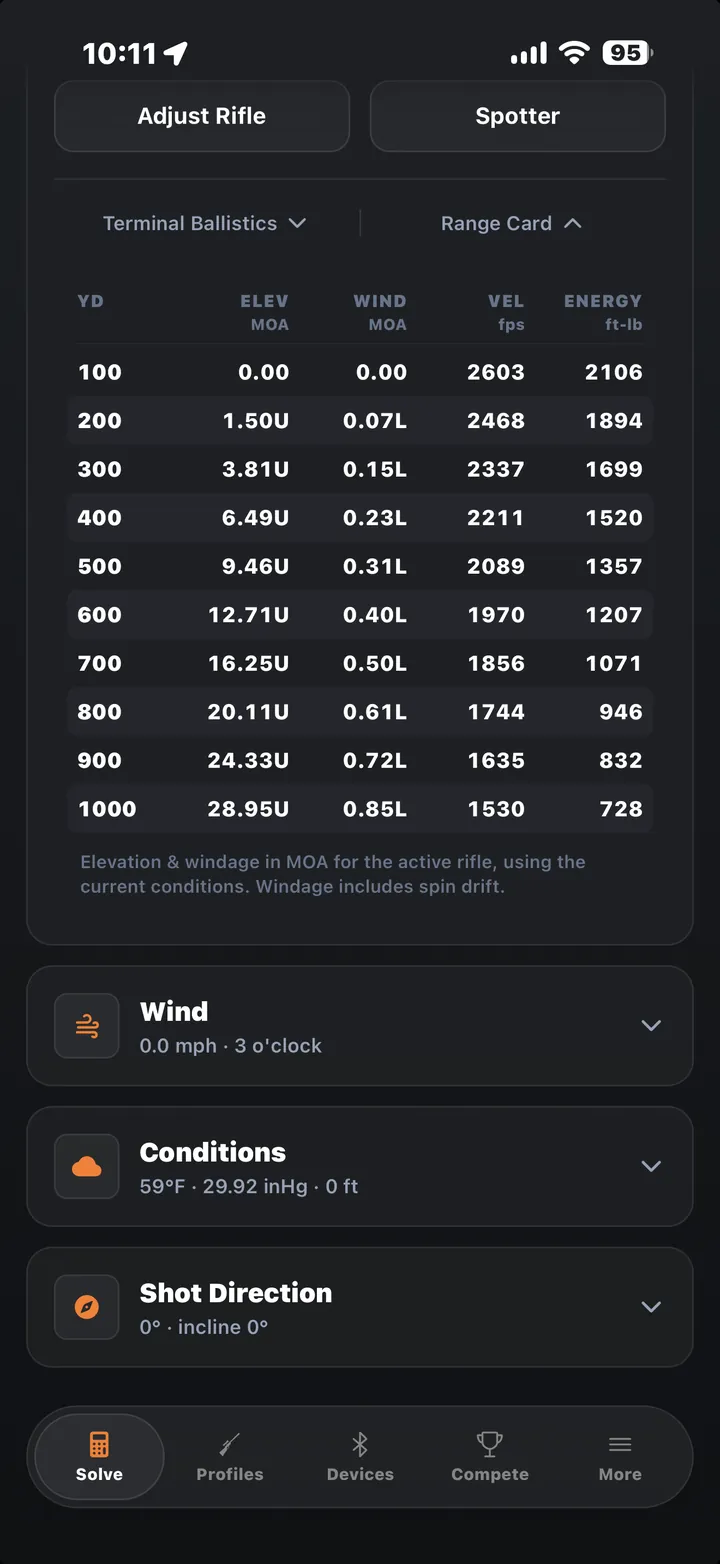
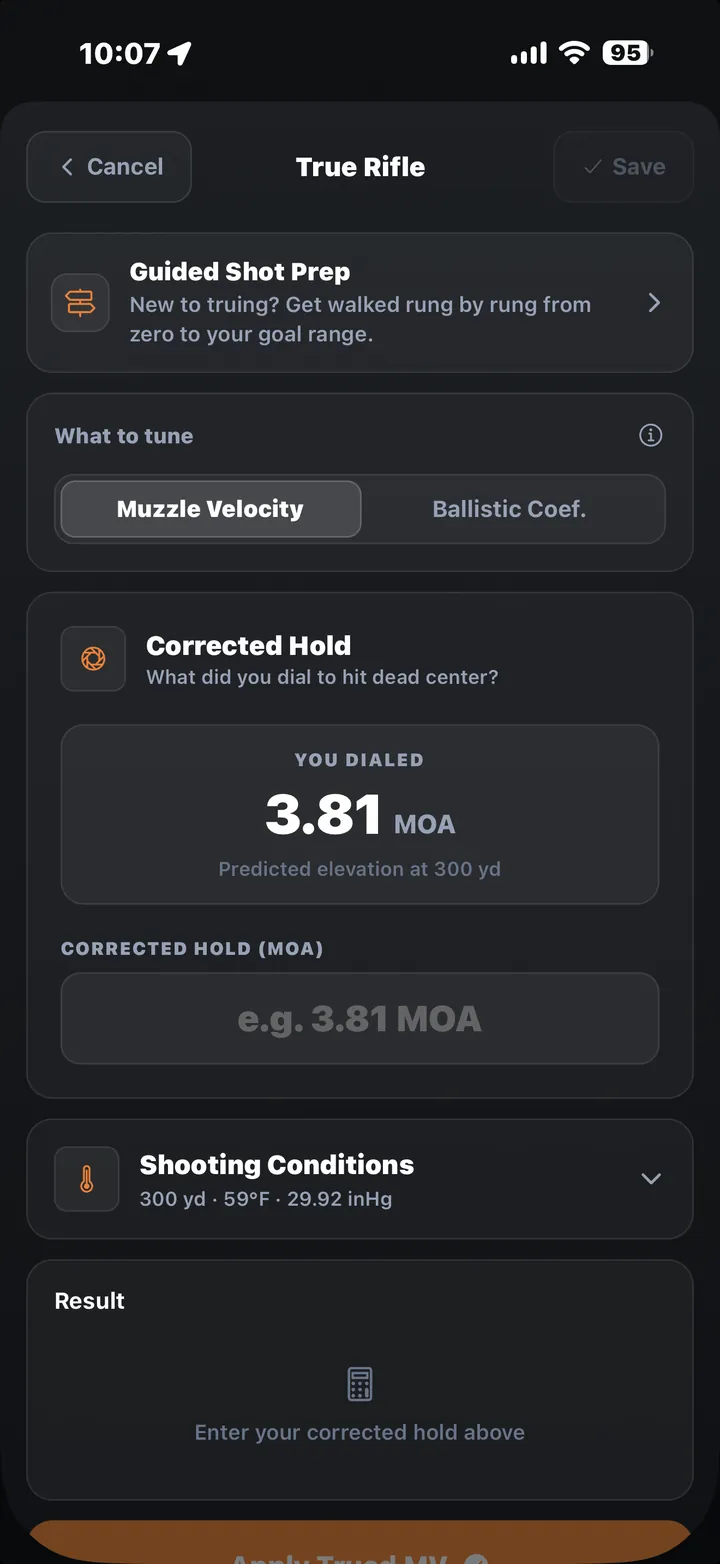
Enter one real impact at distance and Atlas solves your true muzzle velocity so the whole drop chart matches your rifle. No brand calculator can true a solution.
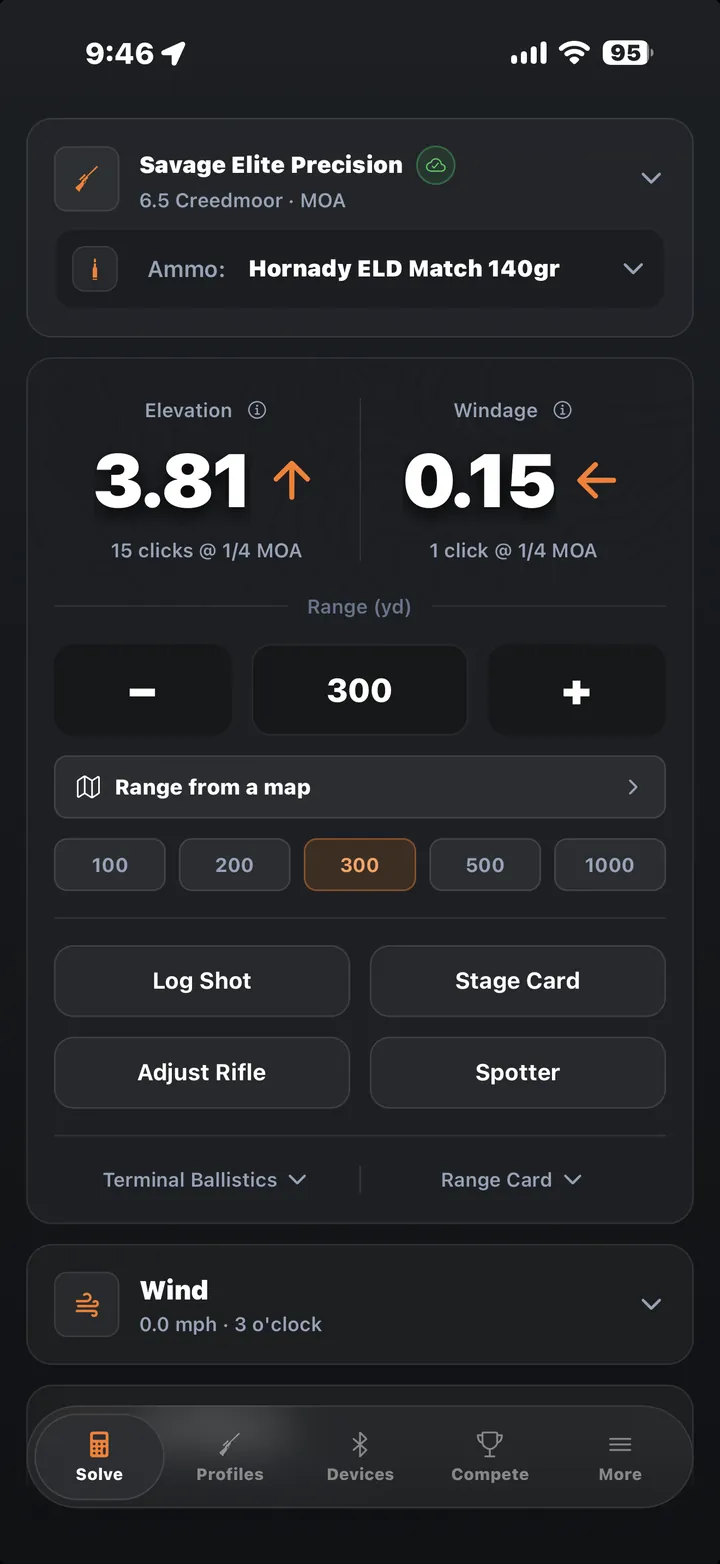
Every correction on one screen
Elevation, windage, spin drift and Coriolis are shown as separate lines, so you know exactly what you are holding for and why.
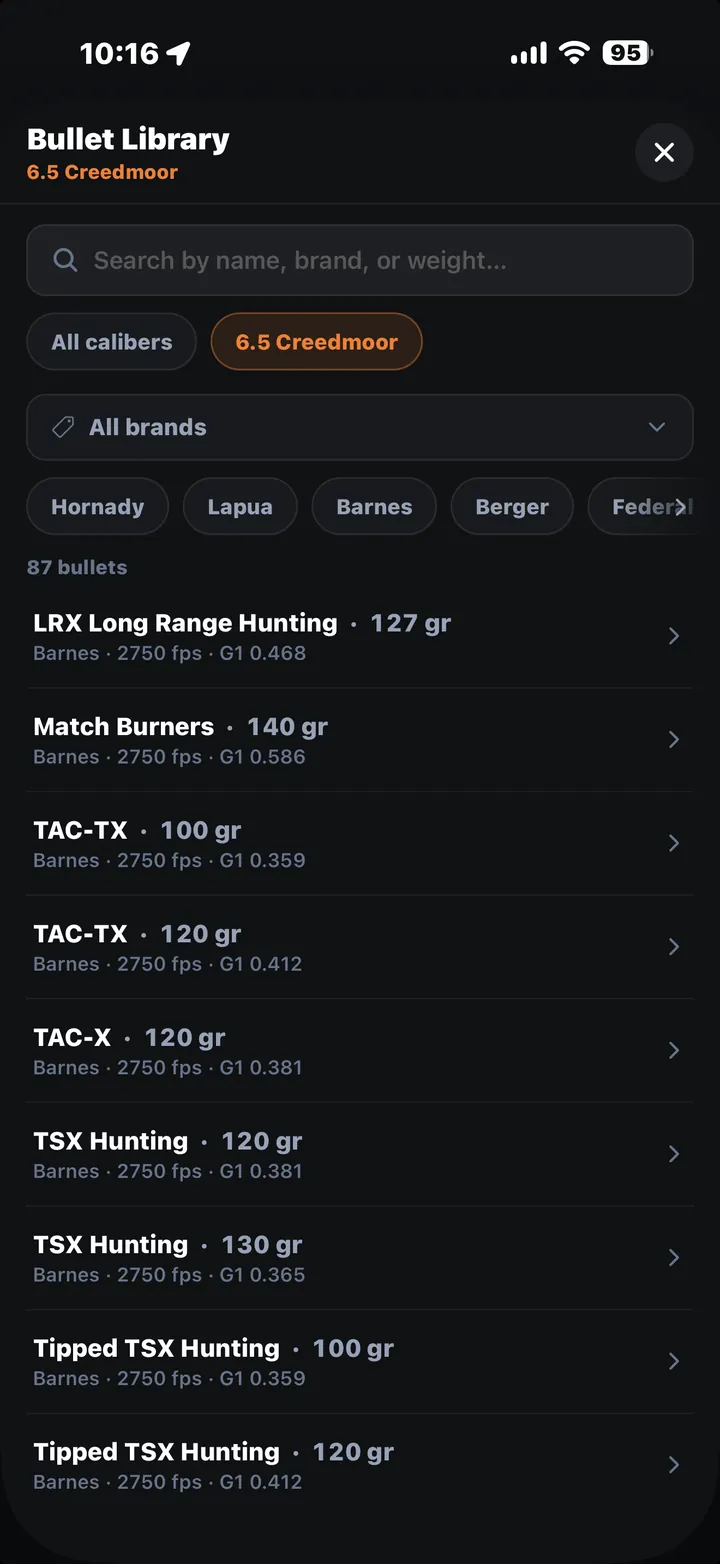
935 bullets, not one brand
399 factory loads from 21 manufacturers plus 536 bullets, or add your own. Switch loads without leaving the app.
Stage cards for match day
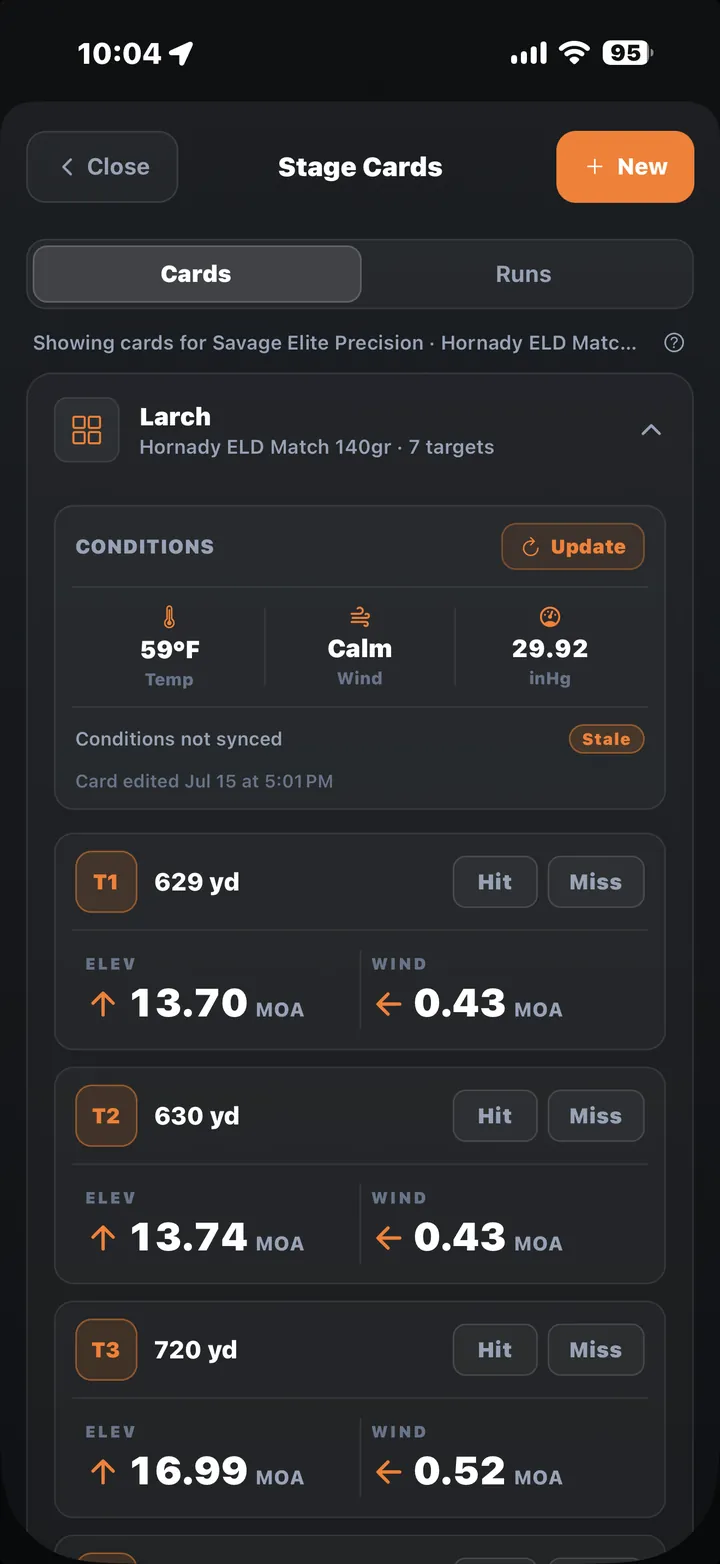
Build every target on a stage with its own solve, run it on the clock, and review hits and misses after.
Why Each Brand's Own Calculator Has Limits
Brand-specific ballistic calculators are siloed by design. A hunter comparing Federal Trophy Bonded against a Nosler Partition load has to open multiple tabs, re-enter atmospheric conditions each time, and reconcile outputs that may have been computed with different drag models and different atmosphere assumptions. That friction is the core problem this page addresses.
G1 versus G7 drag models. Most brand tools use the G1 drag model exclusively. G1 is calibrated to a flat-based, blunt-nosed projectile, not a modern boat-tail spitzer. For boat-tail bullets beyond 500 yd, G1 BC produces increasingly optimistic velocity and drop predictions because the reference projectile and the actual bullet diverge in their drag behavior across the transonic and supersonic range. G7 is calibrated to a long-range boat-tail standard and is the correct model for modern rifle bullets at distance. Several brands still do not publish G7 BCs openly, and their tools do not offer a G7 option.
Atmosphere correction. Methodology varies. Some tools apply a density altitude correction; others assume ICAO standard atmosphere silently. At 5,000 ft elevation in summer heat, standard-atmosphere outputs can be off by several MOA at 600 yd, enough to miss a vital zone on an elk.
No truing. None of the brand calculators allow you to adjust MV or BC to match observed impact data. Truing is how a firing solution becomes accurate for your rifle, your barrel, your lot of ammunition, not just accurate in theory.
No shot logging. Zero-data field use means no record of what actually hit where, under what conditions. Truing without logging is guesswork.
Mobile UX. Most brand calculators are desktop-oriented web tools. Field use on a phone, gloves, sunlight, wind, is an afterthought.
Remington's standalone ballistic calculator was discontinued; users now rely on third-party solvers or printed reloading manual data. That is a real gap, not a minor inconvenience, for anyone hunting with Core-Lokt or Core-Lokt Tipped loads at extended range.
Federal Ballistic Calculator — Premium Loads Breakdown
Federal Premium's online ballistic calculator covers their product line and is reasonably well-maintained, but it uses G1 BC and standard atmosphere by default. For precision work, that combination has meaningful limitations.
Gold Medal Match. The 308 Win 175gr Sierra MatchKing load is the industry reference for precision rifle. Federal publishes a G7 BC of 0.243 for the 175gr SMK. The 168gr SMK G7 BC is approximately 0.223. Federal's Gold Medal Berger loads use Berger Hybrid projectiles with G7 BCs in the 0.273–0.304 range depending on caliber, these are high-BC target bullets that reward a G7-based solver.
Terminal Ascent. Federal's bonded hunting bullet with a slippery profile. The 175gr .308 Terminal Ascent carries a published G1 BC of approximately 0.530, which translates to a G7 BC around 0.270, high for a bonded hunting bullet. At 600 yd the retained velocity advantage over a conventional Core-Lokt is substantial.
Power-Shok and Fusion. Workmanlike hunting loads with modest BCs. G1 BCs in the 0.310–0.390 range depending on bullet weight and caliber. Adequate for shots inside 400 yd where wind hold and drop are manageable without a trued solution.
Why atmosphere matters, a worked example.
| Range (yd) | Drop, Standard Atmo (in) | Drop, 5,000 ft DA (in) | Difference (MOA) |
|---|---|---|---|
| 100 | 0.0 (zero) | 0.0 (zero) | 0.0 |
| 300 | −13.1 | −12.6 | −0.5 |
| 500 | −52.4 | −49.8 | −0.5 |
| 700 | −138.2 | −129.7 | −1.2 |
308 Win 175gr SMK, 2,600 fps MV, 100 yd zero. Values approximate, your conditions will differ.
At 700 yd the atmosphere difference alone is over one MOA. Federal's online tool, run at standard conditions, will not show you that. Enter your actual elevation, temperature, and pressure into a solver that corrects for density altitude.
Remington, Winchester & Weatherby Ballistic Calculators
Remington. The Core-Lokt line is the best-selling hunting bullet in American history, and for most of its existence Remington provided a standalone ballistic calculator to support it. That tool no longer exists as an independent product. Hunters running Core-Lokt loads today rely on third-party solvers, reloading manual tables, or guesswork.
Worked BC data: 308 Win 150gr Core-Lokt PSP carries a G1 BC of approximately 0.314. The 30-06 Springfield 180gr Core-Lokt PSP is approximately 0.382. Core-Lokt Tipped, the polymer-tipped version introduced to improve BC and terminal performance, improves those numbers meaningfully; the 150gr .308 Tipped runs a G1 BC around 0.415. The distinction matters beyond 400 yd.
Winchester. Winchester's online Ballistics Calculator is available and functional. It uses G1 BC. The Ballistic Silvertip (BST) line has better aerodynamics than traditional cup-and-core hunting bullets. A direct comparison at 400 yd in a 10 mph full-value crosswind:
| Load | G1 BC | Wind Drift @ 400 yd (in) | MOA Hold |
|---|---|---|---|
| Winchester 150gr BST (.308) | ~0.435 | ~10.2 | ~2.4 |
| Remington 150gr Core-Lokt (.308) | ~0.314 | ~14.1 | ~3.4 |
That is roughly a one-MOA difference in wind hold at 400 yd, not trivial on a deer-sized target. At 500 yd the gap widens further. Deer Season XP and Power Point carry lower BCs than BST; use the appropriate data for your chosen load.
Weatherby. Weatherby's user base is loyal and their cartridges are defined by velocity. The .257 Weatherby Magnum and 6.5-300 Weatherby Magnum push muzzle velocities that reduce wind and drop sensitivity at moderate range, but beyond 600 yd, BC reasserts itself and the high-velocity advantage narrows. Weatherby's factory Select Plus loads often use Nosler AccuBond or Barnes TTSX projectiles; pull the BC from the component manufacturer, not the Weatherby selector, for the most accurate G7 value. Weatherby's online tool is basic and does not apply atmosphere correction.
Nosler, Barnes, Sierra & Norma Ballistic Calculators
Nosler. AccuBond and Partition projectiles appear in Federal, Weatherby, and Nosler Trophy Grade factory loads. Nosler publishes both G1 and G7 BCs for the AccuBond Long Range line, a practice worth noting because it is not universal. The 168gr AccuBond Long Range in 30 caliber carries a G7 BC of 0.263. Nosler's online ballistic calculator is reasonably functional for load selection but does not support atmosphere truing or shot logging.
Barnes. TSX and LRX monolithic copper bullets are popular with hunters who prioritize penetration and weight retention. Barnes publishes G1 BCs for their factory and component lines. One technical note every Barnes shooter needs: monolithic all-copper bullets typically require a 50–100 fps lower MV input than an equivalent-weight jacketed lead bullet to produce accurate downrange predictions in most solvers. The longer bearing surface of a monolithic bullet generates different friction characteristics at the muzzle; chronograph data from your rifle is the only authoritative input. Barnes's online calculator is functional but not field-optimized.
Sierra. Sierra MatchKing BCs are among the most rigorously measured in the industry. Sierra tests at multiple velocity nodes and publishes results in their reloading manual, meaning the BC value changes across the velocity envelope rather than being a single averaged number. For the 168gr SMK, the G7 BC is approximately 0.223 above 1,800 fps. For the 175gr SMK, G7 BC is approximately 0.243. Sierra's free online tool is basic. Their Infinity ballistic software is a desktop application with a legacy architecture, accurate, but not field-usable on a phone.
Norma. Swedish manufacturer with a well-maintained online calculator covering their factory loads. The Bondstrike line is gaining US market share; the Bondstrike 230gr .338 carries a published G7 BC of 0.368, a genuine long-range hunting projectile. Norma's tool handles their product line cleanly but lacks truing, logging, and field UX.
All four brands publish accurate BC data. None of their calculators support the truing-and-logging workflow that precision shooting requires.
How to True Your Ballistic Solution Regardless of Brand
Manufacturer BC and MV values are starting points, not confirmed firing solutions. Every barrel, every lot of ammunition, and every environmental condition introduces variables that published specs cannot account for. Truing is the process of correcting your solver's solution to match actual observed impacts.
Step 1, Load manufacturer data. Enter the published G1 or G7 BC and factory-stated MV into your solver. Use G7 if available; if you only have G1, use it, but recognize the prediction will degrade beyond 500 yd for boat-tail bullets.
Step 2, Shoot at a known distance. A 3–5 shot group at 300–600 yd is the practical truing window. Far enough to reveal meaningful error; close enough to remain comfortably supersonic for most cartridges.
Step 3, Measure the discrepancy. Compare your actual group center to the solver's predicted drop, in MOA or mrad. Record the difference precisely.
Step 4, Adjust MV first. Adjust MV, not BC, as your first variable. MV is a single scalar that shifts the entire solution predictably. A 50 fps MV error on a 175gr SMK at 600 yd produces approximately 1.5 MOA of drop error. If your group is high relative to prediction, your effective MV is faster than the solver shows; lower it. If low, raise it. Do not adjust both MV and BC simultaneously, you cannot isolate the correction.
Step 5, Validate at a second distance. Fire a confirming group at a different range, ideally 200–300 yd beyond your truing distance. If it matches, your solution is trued. If it does not, the BC may also need adjustment.
Step 6, Re-true when lot numbers change. Factory MV varies 40–50 fps lot-to-lot. A trued solution tied to one lot is not guaranteed to transfer. Chronograph new lots; update accordingly.
None of the brand calculators support this workflow. It requires a solver that stores a trued MV, applies it consistently across your drop table, and logs what you shot, where, and under what conditions.
Choosing the Right Ballistic Calculator for Your Shooting
The brand tools serve a legitimate purpose: they are the authoritative source for BC and factory MV data. Use them for that. For everything that happens after you have the data, you need a solver that was built for field shooting.
| Feature | Atlas | Federal Online | Winchester Online | Nosler Calculator | Barnes Calculator | Sierra Infinity |
|---|---|---|---|---|---|---|
| G7 BC support | Yes | No | No | Partial | No | Yes |
| Atmosphere correction | Yes | No | No | No | No | Yes |
| Truing / MV adjustment | Yes | No | No | No | No | Manual |
| Wind holds | Yes | Yes | Yes | Yes | Yes | Yes |
| Shot logging | Yes | No | No | No | No | No |
| Mobile field use | Yes | Poor | Poor | Poor | Poor | No |
| Free | No* | Yes | Yes | Yes | Yes | No |
*Atlas is free to download on iOS and Android, with an optional Pro subscription. Sierra Infinity is paid desktop software.
The recommended workflow: pull BC and factory MV from the brand source, Federal's product page, Sierra's reloading manual, Nosler's published G7 data. Enter those values into a full-featured solver. True against live fire at a known distance. Log your data by load and condition. Pull up the field-ready drop card on your phone when it matters.
Brand calculators are a useful first check. They are not a firing solution.
Frequently Asked Questions
You have the data. Atlas builds the solution.
Every BC and factory MV on this page comes from a manufacturer source, Federal, Sierra, Nosler, Barnes, and the rest publish that data because it is theirs to publish. What they do not provide is a solver that takes that data, lets you true it against live fire at 500 yd, logs the result by load and condition, and puts a field-ready drop card on your phone when you are standing on a ridge glassing at distance. Enter any manufacturer BC and MV into Atlas, run your atmosphere correction, true your solution, and carry it. That is the complete workflow, and the Atlas app on iOS and Android is where it finishes.
Frequently asked questions
Keep reading
Muzzleloader & Airgun Ballistic Calculator
Best Rangefinders with Ballistic Calculator: 2026 Buyer's Guide
Best Ballistic Calculator in 2026: Apps, Software & Handheld Devices Compared
Berger & Vortex Ballistic Calculator – The Atlas Alternative for Precision Shooters
Best Ballistic Calculator Apps in 2026: An Honest Comparison for Precision Shooters
Free Ballistic Calculator: Bullet Drop, Wind Holds & Ballistic Tables
More free ballistic calculators
All free, all in the browser, no download needed.
Ballistic Calculator
Full trajectory table with drop, drift, velocity and energy.
Ballistic Coefficient Calculator & Chart
Estimate effective G1/G7 BC, inspect form factor, and browse bullet reference values.
Muzzleloader & Airgun Calculator
G1/G7 trajectory estimates with specialty-projectile model limitations.
Bullet Energy Calculator
Kinetic energy downrange, against hunting thresholds.
MOA to MIL Calculator
Convert MOA, MIL and inches, and get your scope clicks.
Twist Rate Calculator
Miller stability factor and the twist your bullet needs.
Bullet Stability Calculator
Sg at your velocity, plus sectional density.
Recoil Calculator & Chart
Free recoil in foot-pounds and side-by-side cartridge recoil chart.
Angle Shot Calculator
Uphill and downhill range correction with the cosine rule.
Grains to Grams
Convert bullet and powder weights both ways.
Density Altitude Calculator
Temperature, pressure and humidity turned into density altitude.
MPBR & Optimal Zero
Find a suggested zero and point-blank range for your target-zone size.
Zero Calculator
Sight in at 25 yd for a 100 yd zero, and compare 36, 50 and 100 yd zeros.