Best Ballistic Calculator in 2026: Apps, Software & Handheld Devices Compared
Compare the best ballistic calculators of 2026: Strelok, JBM, Kestrel, Caldwell and Atlas. See which gives the most accurate firing solution.
- Strelok Pro — best budget phone app with a huge reticle library. Dated interface, one-time purchase.
- JBM Ballistics — best free web calculator for checking numbers at a desk. No app, no offline use, no truing.
- Kestrel with Applied Ballistics — best if you want a rugged dedicated device with a built-in weather meter. Costs several hundred dollars.
- Atlas Ballistics — best all-round app (iPhone, iPad, Mac and Android): any bullet, truing, spin drift, Coriolis, stage cards and a shot log, fully offline.
Bottom line: if you shoot past 600 yards from your phone, Atlas covers the most ground for the least money.
Feature-by-feature comparison
| Feature | Strelok Pro | JBM | Kestrel AB | Atlas |
|---|---|---|---|---|
| Ballistic model | ||||
| Drag model | G1, G7 | G1, G7, others | AB custom curves | G1, G7 + drag factor tuning |
| Spin drift | ||||
| Coriolis | ||||
| Aerodynamic jump | ||||
| In the field | ||||
| Truing to your rifle | MV truing (Pro) | |||
| Works offline | ||||
| Built-in weather sensor | ||||
| Stage cards / DOPE export | yes (Pro) | |||
| Shot logging | ||||
| Access | ||||
| Platform | iOS, Android | Web | Handheld device | iOS, Android |
| Cost | One-time purchase | Free | $$$ device | Free, Pro $5.99/mo |
Capability coverage
Share of the 6 long-range capabilities in the table above that each tool supports.
Which one should you pick?
Strelok Pro
Choose it if: you want a cheap, proven app on Android or iOS.
- Large reticle library
- Works offline
- Dated, cluttered interface
- No stage cards or shot log
JBM
Choose it if: you want to double-check a solution on a computer.
- Free and well respected
- Lots of solver options
- Web only, needs signal
- No truing or saved profiles
Kestrel AB
Choose it if: you want one rugged device with weather built in.
- Live wind and atmosphere sensor
- Applied Ballistics solver
- Hundreds of dollars
- Small screen, slow data entry
Atlas
Choose it if: you shoot long range on iPhone or Android and want everything in one app.
- 935 loads and bullets from any brand, plus your own
- Spin drift, Coriolis and aero jump built in
- Works offline, with stage cards and a shot log
- Requires internet only for live weather and AI box scanner
- Truing, stage cards and shots past 300 yd need Pro
What you get that the others don't
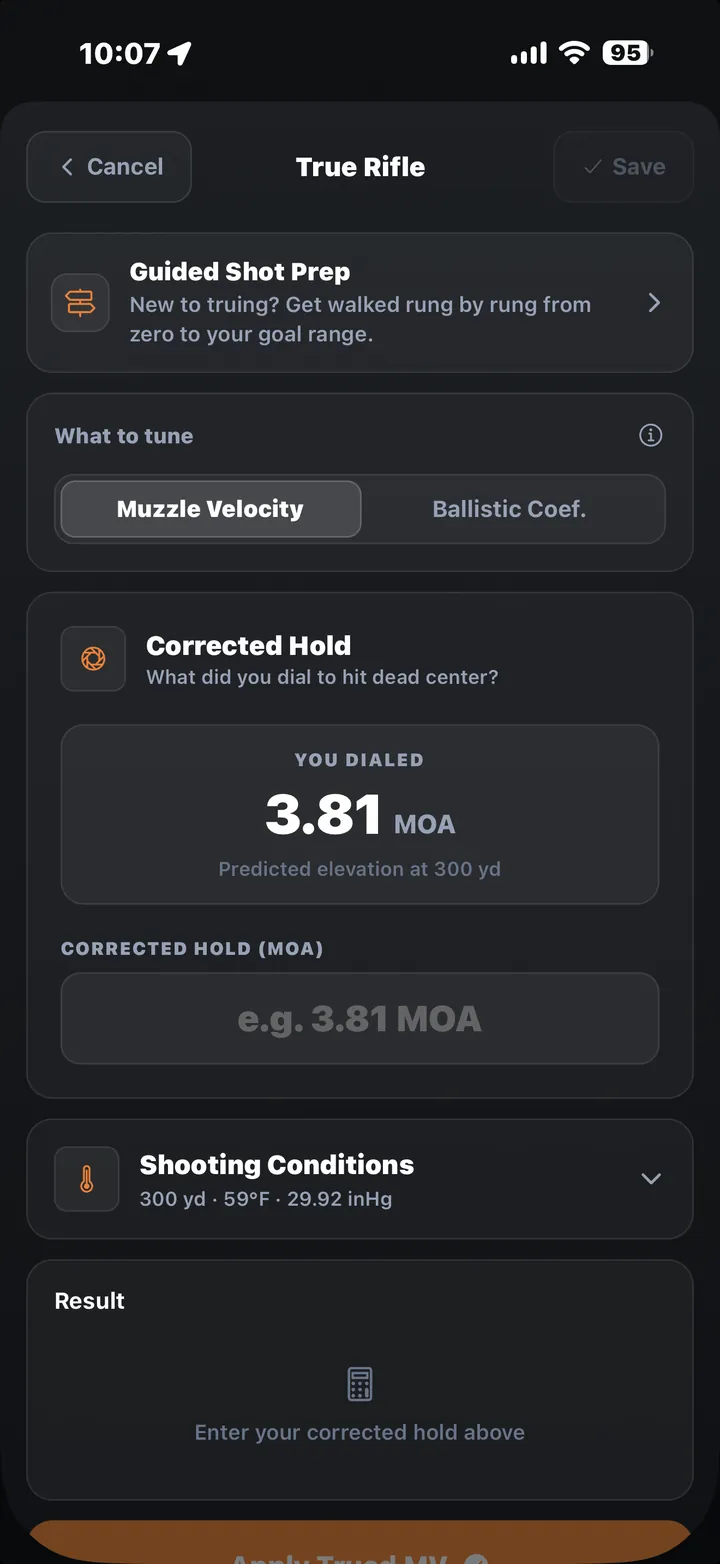
True your rifle in minutes
Enter one real impact at distance and Atlas solves your true muzzle velocity so the whole drop chart matches your rifle. JBM has no truing, and Strelok only offers a basic version.
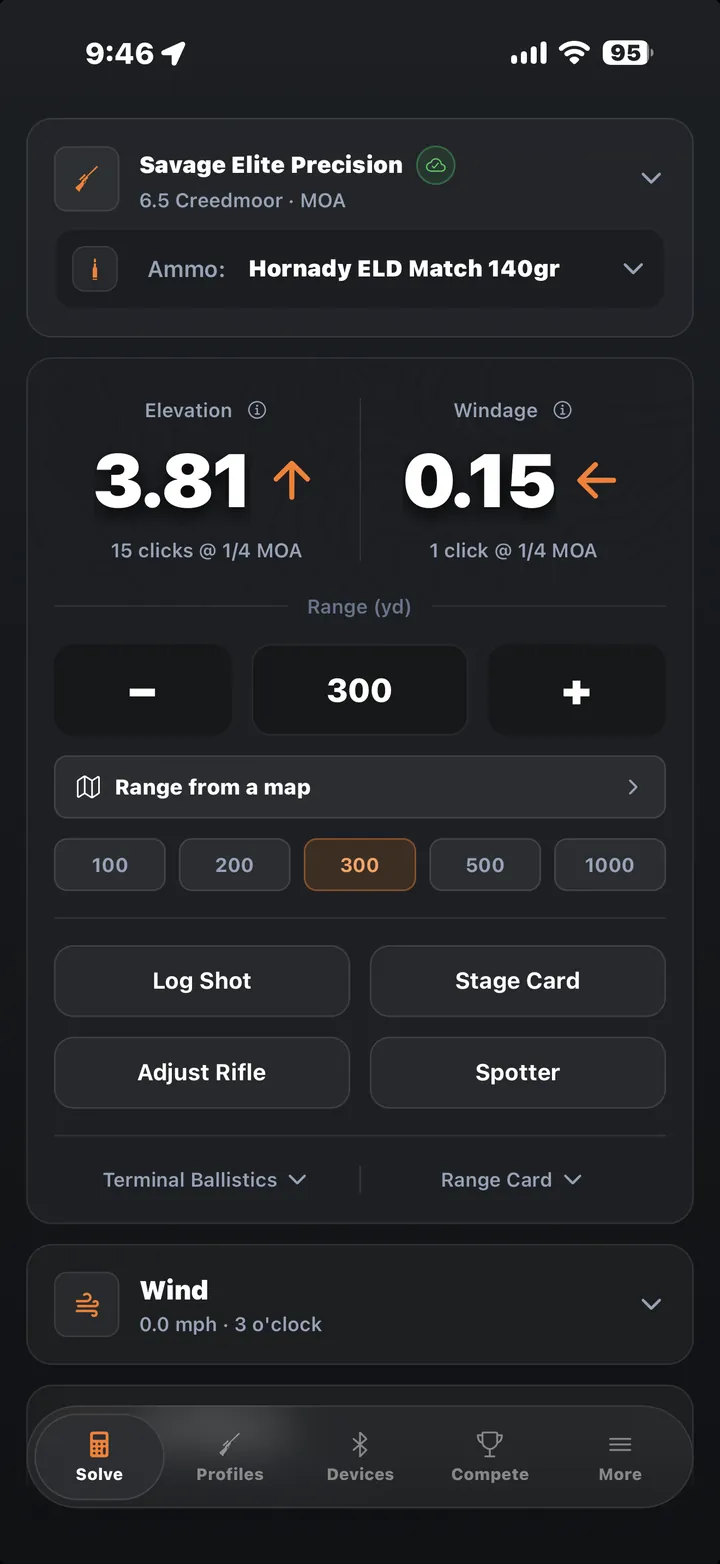
Every correction on one screen
Elevation, windage, spin drift and Coriolis are shown as separate lines, so you know exactly what you are holding for and why.
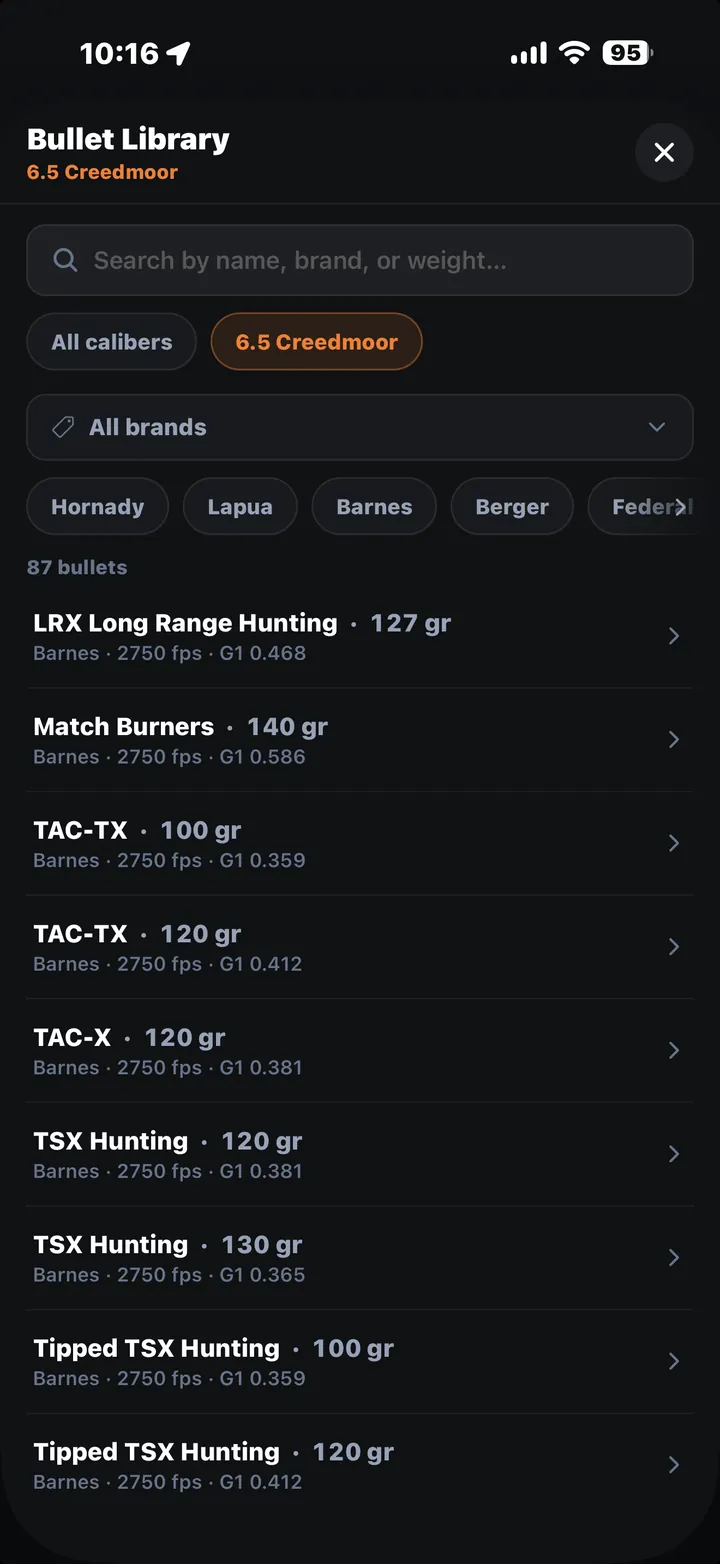
935 bullets, not one brand
399 factory loads from 21 manufacturers plus 536 bullets, or add your own. Switch loads without leaving the app.
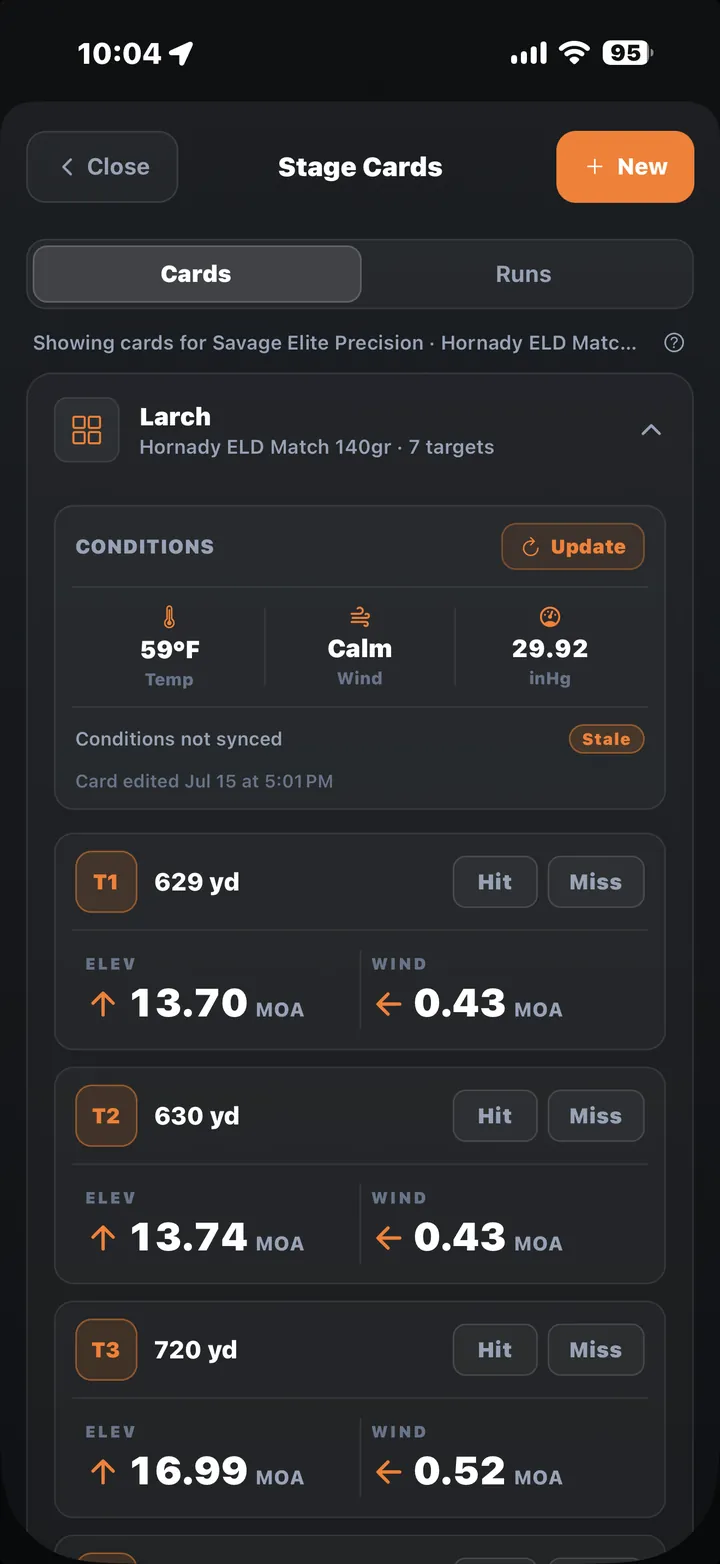
Stage cards for match day
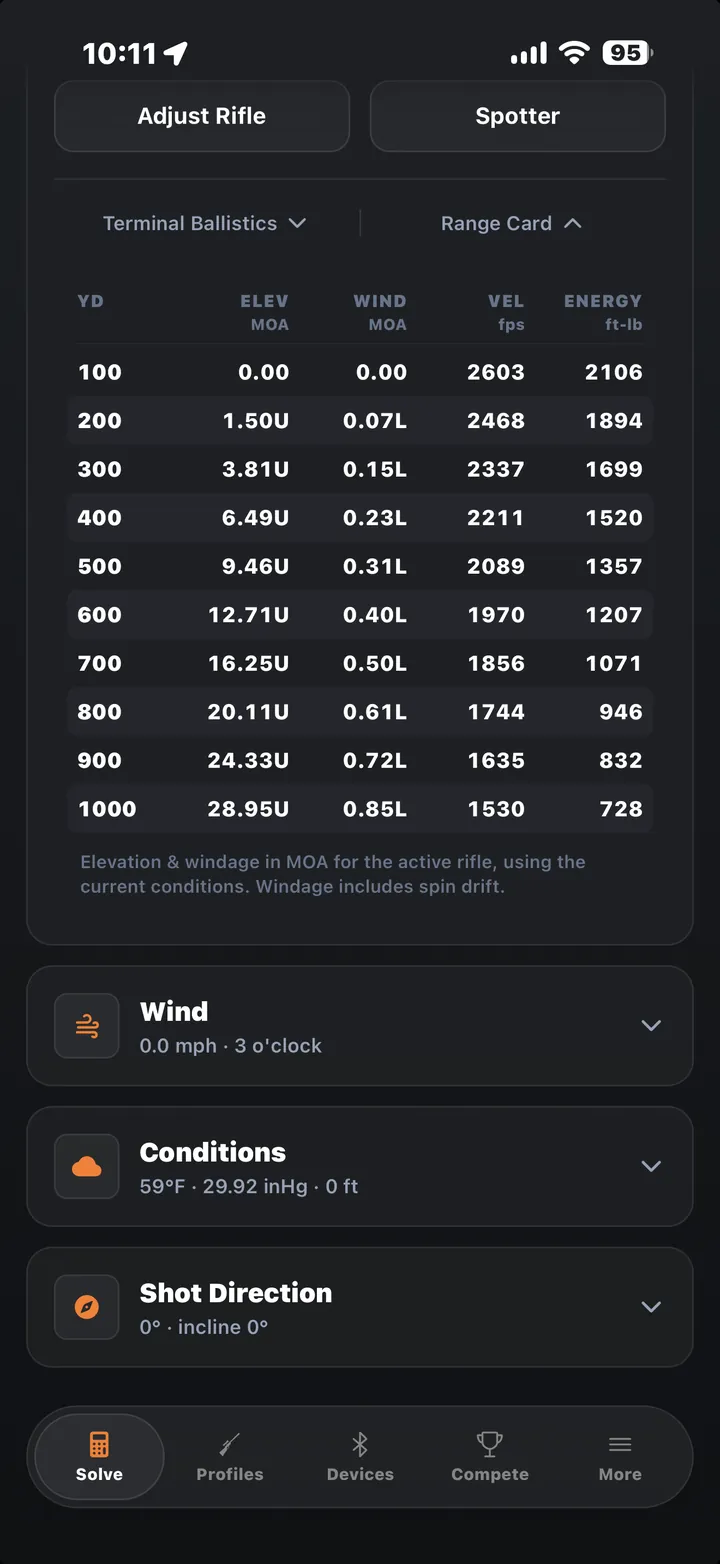
Build every target on a stage with its own solve, run it on the clock, and review hits and misses after.
What Makes a Ballistic Calculator Actually Accurate?
Before comparing products, it is worth establishing what drives solver accuracy, because a polished interface on top of a weak physics engine still produces bad firing solutions.
Drag models
Every ballistic solver needs a drag model to predict how quickly a bullet decelerates. The two most common standard models are G1 and G7. G1 was derived from a flat-based, blunt-nosed projectile and remains the reference for most published BC values. G7 was derived from a long, boat-tail projectile that more closely matches modern long-range rifle bullets. At extended range, using a G1 BC with a G7-shaped bullet overpredicts drag, which means your wind corrections and drop values diverge from reality. G7 is the preferred model for any sleek, boat-tail bullet past 500 yards. Custom drag curves (CDM or CDL) go further, they map measured drag across the entire velocity envelope and are the most accurate approach available, though they require either manufacturer-supplied data or a Doppler-derived curve.
Atmosphere and density altitude
Air density directly affects drag. Rather than inputting altitude, temperature, pressure, and humidity as four independent variables, a well-built solver collapses them into density altitude (DA), a single value referenced to the ICAO standard atmosphere (15°C, 1013.25 hPa at sea level). Higher DA means thinner air, less drag, and a flatter trajectory. Solvers that skip humidity or use a simplified atmosphere model introduce small but real errors at extended range.
Spin drift and Coriolis
Spin drift causes a bullet to drift in the direction of rifling twist, typically right for right-hand twist barrels. Coriolis acceleration is a function of latitude, firing azimuth, and time of flight. Both effects are small inside 600 yards and significant past 800. Many free tools and budget apps ignore them. At 1,000 yards with a 175gr bullet, spin drift alone can account for 0.5–1.0 MOA of uncorrected error.
Truing
Truing is the process of adjusting the solver's modeled muzzle velocity or BC until its predicted impact matches your observed impact at a known distance in known conditions. It is the single largest accuracy driver in practical long-range shooting. A solver with mediocre physics but a good truing workflow will outperform a solver with excellent physics and no truing capability in real-world use. Shoot at a known distance, record the actual impact, adjust MV or BC until the solver agrees, save the profile.
Scope tracking and click values
Inputting your actual turret click value, whether MOA (1.047" at 100 yd) or MRAD (3.6" at 100 yd), matters when building a DOPE card. A solver that outputs only one unit while your scope tracks in another forces mental conversion under time pressure, which is a source of field errors.
Caldwell Ballistic Calculator: How It Compares
If you searched for the Caldwell ballistic calculator, you are probably weighing a simple free tool against a full app. Caldwell's calculator is aimed at quick drop and wind holds. It is a reasonable way to get a starting number.
Where a dedicated app pulls ahead is everything after the first solution: truing against your real impacts, spin drift and Coriolis past 600 yards, your own bullet and reticle data, and working without cell signal. If you shoot past a few hundred yards, those matter more than the interface. The comparison table below shows how Caldwell, Strelok, JBM, Kestrel and Atlas line up.
Ballistic Calculator Comparison: Strelok, JBM, Kestrel, Caldwell & More
Comparison table
| Calculator | Platform | Drag Models | Spin Drift / Coriolis | Truing | Range Card Export | Cost |
|---|---|---|---|---|---|---|
| Strelok | iOS / Android | G1 | No / No | No | Yes | Free |
| Strelok Pro | iOS / Android | G1, G7, CDM | Yes / Yes | Limited | Yes | ~$10 |
| JBM | Browser | G1, G7, G2, GL | Yes / Yes | Manual | Yes (text) | Free |
| Kestrel 5700 AB Elite | Dedicated device | G1, G7, CDM | Yes / Yes | Yes | Yes | ~$800 |
| Kestrel 5700 Hornady | Dedicated device | G1, G7, 4DOF | Yes / Yes | Limited | Yes | ~$700 |
| Caldwell Ballistic Precision | Dedicated device | G1 | No / No | No | Limited | ~$60–$120 |
| Shooter (Patagonia Ballistics) | iOS / Android | G1, G7 | Yes / Yes | Yes | Yes | ~$10 |
| Atlas Ballistics | iOS / Android | G1, G7 | Yes / Yes | Yes | Yes | Free / IAP |
Strelok / Strelok Pro
Strelok is one of the longest-running ballistic calculator apps and has a particularly strong following in the European long-range community. The free version is limited to G1 and lacks spin drift and Coriolis corrections. Strelok Pro adds G7, custom drag, wind components, and spin drift, making it a legitimate solver for precision work. The user interface is functional but dated, and the bullet library is large enough to cover most common cartridges. There is no hardware weather integration; all atmospheric data must be entered manually. For a shooter on Android who wants a capable G7 solver at low cost, Strelok Pro is a reasonable choice.
JBM Ballistic Calculator
JBM is the browser-based reference tool that serious handloaders and ballisticians use for desktop verification. It supports G1, G7, G2, and GL drag functions, includes spin drift and Coriolis, and outputs detailed range tables. Its value is in pre-load and pre-trip verification, paste in your data, confirm your DOPE table looks right before driving to the range. It is not a field tool. There is no mobile app, no offline mode, and no profile storage in the way a phone app provides. Use JBM to sanity-check numbers from your primary app; do not treat it as a replacement for a field solver.
Kestrel Ballistic Calculator (5700 Series)
The Kestrel 5700 with Applied Ballistics Elite firmware is the standard against which every other portable ballistic calculator is measured. It integrates live temperature, pressure, humidity, and wind speed from onboard sensors, eliminating the manual weather-entry step that is the primary source of atmospheric error in field conditions. Applied Ballistics Elite supports G7, custom drag curves, spin drift, Coriolis, and a full truing workflow. The Hornady 4DOF variant uses a physically derived aerodynamic model instead of a BC-based approach. At $700–$900, it is a serious investment. It is the right tool for competitors who need rapid, sensor-fed firing solutions and for hunters who operate in rapidly changing mountain weather.
Caldwell Ballistic Precision
The Caldwell is a budget handheld ballistic calculator aimed at entry-level hunters. It runs a G1-only solver, has a limited bullet library, and does not support spin drift or Coriolis. At its price point it is an adequate tool for hunters shooting inside 500 yards with common hunting bullets, where the G1 model's inaccuracies are not yet consequential. It is not a tool for precision rifle competition or extended-range work, and its solver accuracy does not justify choosing it over a free phone app with a stronger physics engine.
Shooter (Patagonia Ballistics)
The Shooter app runs a solid G1/G7 solver with spin drift and Coriolis, a clean interface, and a good truing workflow. It is popular among PRS shooters and is available on both iOS and Android. The bullet library is well-maintained, and the app handles MOA and MRAD outputs cleanly. It is a capable competitor to Atlas Ballistics and a fair choice for any precision shooter who wants a polished phone-based solution.
Atlas Ballistics
Atlas Ballistics is a ballistic calculator for iOS and Android built for precision rifle shooters and hunters. It runs G1 and G7 drag models with spin drift and Coriolis enabled by default, implements a truing workflow that saves adjusted profiles, logs shots with atmospheric conditions, and includes a stage card builder for PRS and NRL competition. It is covered in detail in the next section.
Atlas Ballistics: Why It's Our Top Pick for Shooters
This recommendation is based on feature set and solver capability, not because this is the Atlas Ballistics website. The comparison above is accurate; read it and form your own conclusion. Here is why Atlas Ballistics earns the top position for iOS and Android shooters.
Solver accuracy
Atlas runs G1 and G7 drag models with spin drift and Coriolis corrections enabled by default, not buried in an advanced settings menu. Atmospheric correction uses density altitude computed from your entered altitude, temperature, and pressure. The solver takes sight height above bore as an input, which matters for near-distance corrections and for computing the near-zero crossing accurately.
Truing workflow
The truing process in Atlas follows the correct methodology: shoot at a verified distance in known conditions, note the actual impact relative to point of aim, then adjust the modeled muzzle velocity (preferred) or BC until the solver's predicted impact matches. Atlas saves the trued profile separately from the factory inputs, so you retain both the manufacturer data and your field-verified data. This is how accurate DOPE is built, not by trusting a box label.
As a worked example to sanity-check against your own data: a 175gr Sierra MatchKing with a G7 BC of 0.301, launched at 2,600 fps, zeroed at 100 yards, at sea level, standard conditions, with a 10 mph full-value (90°) wind, produces approximately 10.2 MOA of drop and 2.0 MOA of wind drift at 1,000 yards. Your trued MV and actual atmospheric conditions will shift those numbers, treat this as a reference point, not a firing solution.
Shot logging
Every shot can be logged with target range, atmospheric conditions at time of shot, observed impact, and notes. Over a season this builds a personal DOPE database tied to real-world conditions rather than theoretical predictions, particularly valuable for hunters who return to the same elevations and temperature ranges year over year.
Stage cards
For PRS and NRL competitors, Atlas includes a stage card builder. Before the stage brief ends, you can build a card with each target's distance, your computed wind hold, and elevation correction, then screenshot or export it. This replaces handwritten DOPE cards and removes the arithmetic step from under the timer.
Portability and cost
A phone-based solver means the ballistic calculator is always in your pocket. For shooters who do not need the live sensor integration of a Kestrel, Atlas delivers the solver capability at a fraction of the hardware cost. Manual weather input takes roughly 30 seconds and is accurate if your source data is accurate.
The app is actively maintained. Feature updates have continued since launch, which matters for an app where solver correctness is the entire product.
Portable & Handheld Ballistic Calculators vs. Phone Apps: Which Should You Buy?
The core question for shooters researching portable or handheld ballistic calculators is whether a dedicated device is worth the premium over a phone app. The honest answer depends on your use case, not on which category the marketing prefers.
Where dedicated devices win
The Kestrel 5700 series with Applied Ballistics integrates live weather data from onboard sensors. In field conditions, particularly at elevation, in varying wind, or during a cold morning hunt where temperature is dropping, having your weather data automatically fed into the solver eliminates the single biggest source of real-world error in phone-based setups: stale or estimated atmospheric inputs. If you are shooting a PRS or NRL match with multiple stages and need rapid, sensor-current solutions across the day, a Kestrel with live weather is a genuine operational advantage.
A dedicated device also has no battery anxiety relative to your communication and navigation device, and some models are designed for gloved hands and weather exposure in ways that phones are not.
Where phone apps win
The solver math in a quality phone app and a Kestrel with AB firmware is equivalent, the physics engine is not materially different between platforms at the level that matters for practical shooting. The Kestrel's advantage is sensor integration and form factor, not computational superiority. A phone app with accurate manual weather inputs produces firing solutions of identical quality.
Phone screen visibility in direct sunlight is a real concern and worth acknowledging. A high-brightness screen setting helps; so does a phone shade. Battery life is a legitimate field concern for all-day hunts, and a small battery bank addresses it.
Framework for deciding
- PRS/NRL competitor shooting multi-stage matches with live weather changes: A Kestrel 5700 AB Elite is worth serious consideration, particularly if your stage count is high and manual weather re-entry between stages is impractical.
- Precision hunter or recreational long-range shooter: A well-featured phone app running a G7 solver with spin drift, Coriolis, and a truing workflow delivers the accuracy you need. The $700 price difference between a Kestrel and a phone app is real money that can go toward glass, components, or range time.
- Budget-conscious shooter: A free or low-cost phone app with a competent solver will always outperform a cheap dedicated handheld device running a weak G1-only solver. Solver quality is the variable that matters; form factor is secondary.
A handheld ballistic calculator is not inherently more accurate than a phone app. That distinction is marketing, not physics.
How to Choose the Best Ballistic Calculator for Your Use Case
The right ballistic calculator depends on what you shoot, how far, and in what operational context. The decision tree below is organized by shooter type.
Long-range hunter
You need a large bullet library covering common hunting projectiles, reliable atmospheric correction, and a clean DOPE card or range card you can reference in the field. You do not need stage card features. Both Atlas Ballistics and Strelok Pro meet this requirement. Atlas is our top recommendation on both iOS and Android. Ensure your app runs G7 if your bullet has a secant or hybrid ogive, this matters past 500 yards in thin air.
PRS/NRL competitor
You need fast target transitions, reliable truing across a season of data, and ideally a stage card feature that lets you pre-compute solutions before the buzzer. You need MOA and MRAD output that matches your turret. Atlas Ballistics' stage card builder is a direct differentiator here. The Shooter app is also a legitimate option; JBM is not a field tool.
Benchrest and F-Class
Load development and seating depth decisions benefit from JBM's detailed desktop output, run your proposed load through JBM before the match to verify your DOPE table. Carry a phone app to the firing line for any real-time adjustments or wind reads.
Military and law enforcement
Most professional teams are issued Kestrel units with Applied Ballistics or equivalent software under specific qualification and procurement requirements. This audience is not the primary focus of this comparison, but the solver accuracy standards described above apply equally.
Beginner or budget hunter
The free tier of any reputable ballistic app, Atlas Ballistics, Strelok, or Shooter, is a more capable tool than a cheap dedicated handheld device running a basic G1 solver with a thin bullet library. Start with a free app, learn to true it at a known distance, and build your DOPE before spending money on hardware.
The input quality rule
No calculator, regardless of price, platform, or drag model sophistication, outperforms the quality of its inputs. A trued muzzle velocity and a measured or manufacturer-verified G7 BC, entered into a free app, will produce a better firing solution than a factory MV estimate entered into an $800 device. Truing is not optional for serious long-range work; it is the process.
Frequently Asked Questions
See the FAQ section below.
Atlas Ballistics: The Precision Solver That Lives in Your Pocket
You just read what separates a real ballistic calculator from a toy. Atlas Ballistics runs G7, spin drift, Coriolis, a proper truing workflow, shot logging, and stage cards, on iOS and Android, in the field, without a separate $800 device. Download free and run your first firing solution in under two minutes.
Frequently asked questions
Keep reading
Muzzleloader & Airgun Ballistic Calculator
Best Rangefinders with Ballistic Calculator: 2026 Buyer's Guide
Berger & Vortex Ballistic Calculator – The Atlas Alternative for Precision Shooters
Ammo Brand Ballistic Calculators Compared: Federal, Remington, Winchester & More
Best Ballistic Calculator Apps in 2026: An Honest Comparison for Precision Shooters
Free Ballistic Calculator: Bullet Drop, Wind Holds & Ballistic Tables
More free ballistic calculators
All free, all in the browser, no download needed.
Ballistic Calculator
Full trajectory table with drop, drift, velocity and energy.
Ballistic Coefficient Calculator & Chart
Estimate effective G1/G7 BC, inspect form factor, and browse bullet reference values.
Muzzleloader & Airgun Calculator
G1/G7 trajectory estimates with specialty-projectile model limitations.
Bullet Energy Calculator
Kinetic energy downrange, against hunting thresholds.
MOA to MIL Calculator
Convert MOA, MIL and inches, and get your scope clicks.
Twist Rate Calculator
Miller stability factor and the twist your bullet needs.
Bullet Stability Calculator
Sg at your velocity, plus sectional density.
Recoil Calculator & Chart
Free recoil in foot-pounds and side-by-side cartridge recoil chart.
Angle Shot Calculator
Uphill and downhill range correction with the cosine rule.
Grains to Grams
Convert bullet and powder weights both ways.
Density Altitude Calculator
Temperature, pressure and humidity turned into density altitude.
MPBR & Optimal Zero
Find a suggested zero and point-blank range for your target-zone size.
Zero Calculator
Sight in at 25 yd for a 100 yd zero, and compare 36, 50 and 100 yd zeros.