Best Ballistic Calculator Apps in 2026: An Honest Comparison for Precision Shooters
Looking for a ballistic calculator app? We ranked the best free options for iPhone and Android: Atlas, Strelok, Hornady 4DOF and Applied Ballistics.
- Applied Ballistics Mobile — best if you want Doppler-measured drag factor tuning curves and pay for them. Premium price, dense interface.
- Hornady 4DOF — best free app if you shoot Hornady bullets. Weaker outside the Hornady library.
- Strelok Pro — best budget pick on Android and iOS. Dated interface.
- Atlas Ballistics — best modern app on iOS and Android: any bullet, truing, spin drift, Coriolis, stage cards and a shot log, fully offline.
Bottom line: Atlas gives you the most match and hunting workflow per dollar on iPhone and Android. AB Mobile still leads if drag factor tuning curves are all that matters.
Feature-by-feature comparison
| Feature | AB Mobile | Hornady 4DOF | Strelok Pro | Atlas |
|---|---|---|---|---|
| Ballistic model | ||||
| Drag model | AB custom curves | 4DOF (Hornady data) | G1, G7 | G1, G7 + drag factor tuning |
| Bullet library | Large, AB-measured | Mostly Hornady | Large | 935 loads & bullets, any brand |
| Spin drift | ||||
| Coriolis | ||||
| In the field | ||||
| Truing to your rifle | MV truing (Pro) | |||
| Works offline | ||||
| Stage cards / DOPE export | yes (Pro) | |||
| Shot logging | ||||
| Access | ||||
| Platform | iOS, Android | iOS, Android | iOS, Android | iOS, Android |
| Cost | Paid + subscriptions | Free | One-time purchase | Free, Pro $5.99/mo |
Capability coverage
Share of the 4 long-range capabilities in the table above that each tool supports.
Which one should you pick?
AB Mobile
Choose it if: you want Applied Ballistics custom drag curves above all.
- Doppler-measured drag data
- Pairs with Kestrel AB
- Expensive with add-ons
- Busy, dated interface
Hornady 4DOF
Choose it if: you shoot Hornady bullets and want free.
- Free
- Real Doppler data for Hornady bullets
- Best only with Hornady bullets
- No stage cards or shot log
Strelok Pro
Choose it if: you want a cheap, proven app on Android.
- Large reticle library
- Works offline
- Dated interface
- Basic truing
Atlas
Choose it if: you shoot long range on iPhone or Android and want everything in one app.
- 935 loads and bullets from any brand, plus your own
- Spin drift, Coriolis and aero jump built in
- Works offline, with stage cards and a shot log
- Requires internet only for live weather and AI box scanner
- Truing, stage cards and shots past 300 yd need Pro
What you get that the others don't
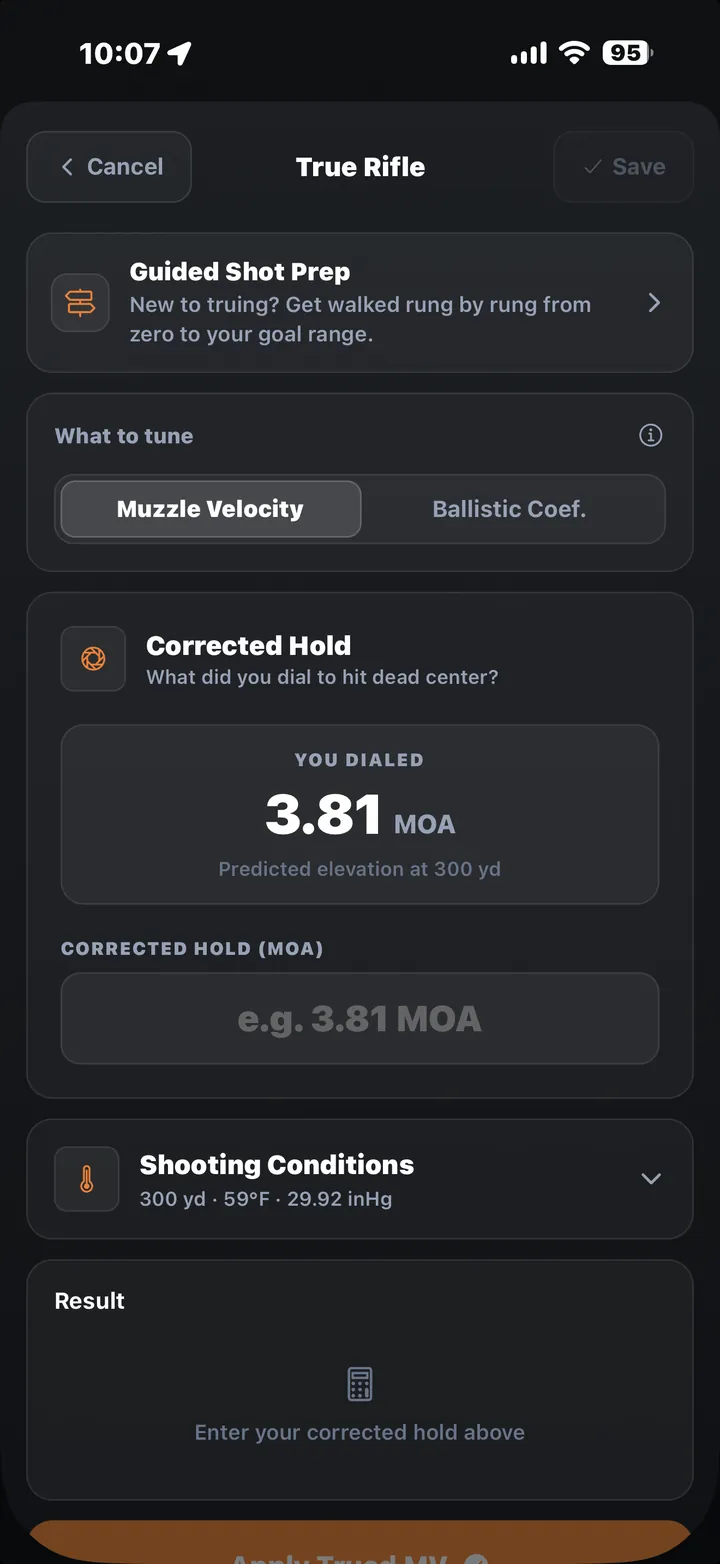
True your rifle in minutes
Enter one real impact at distance and Atlas solves your true muzzle velocity so the whole drop chart matches your rifle. Truing is built in and walks you through it step by step.
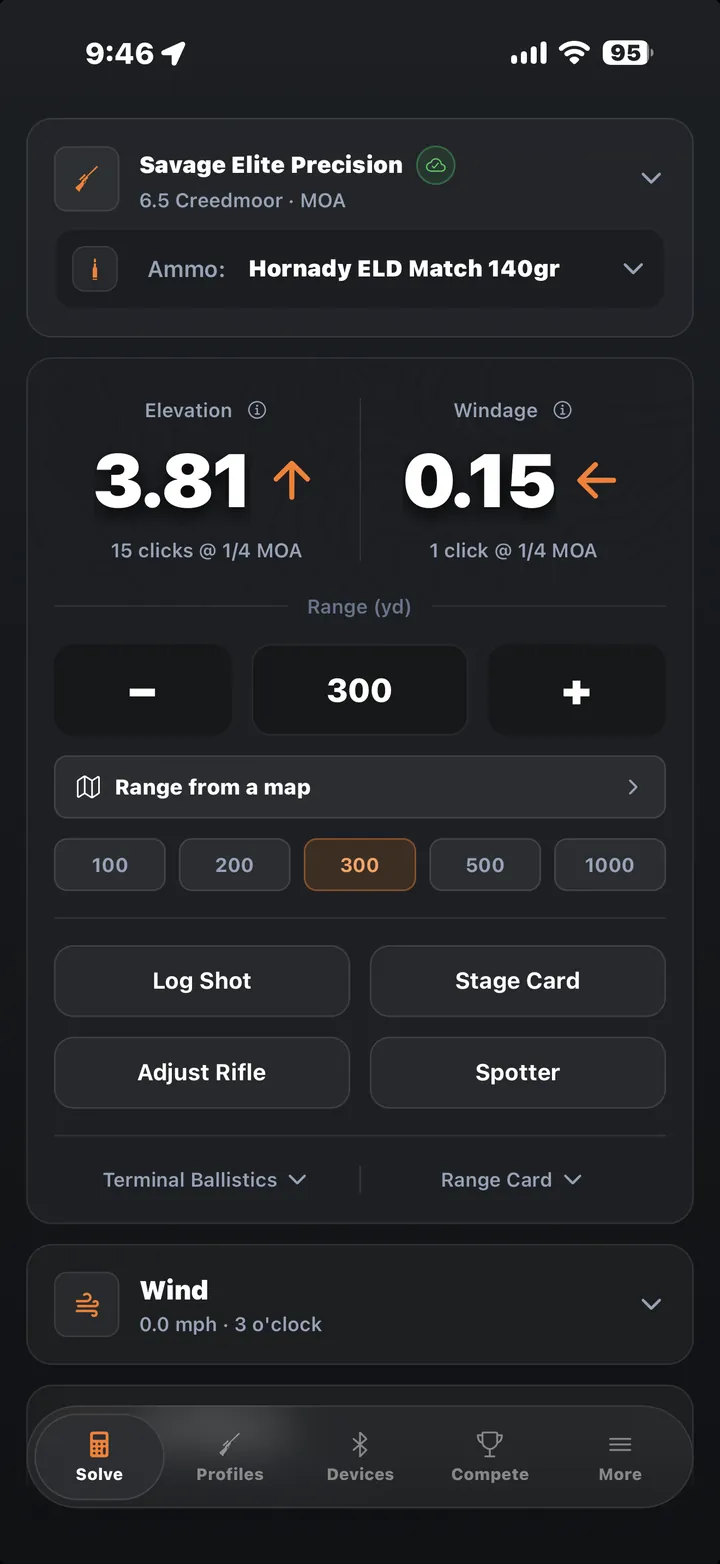
Every correction on one screen
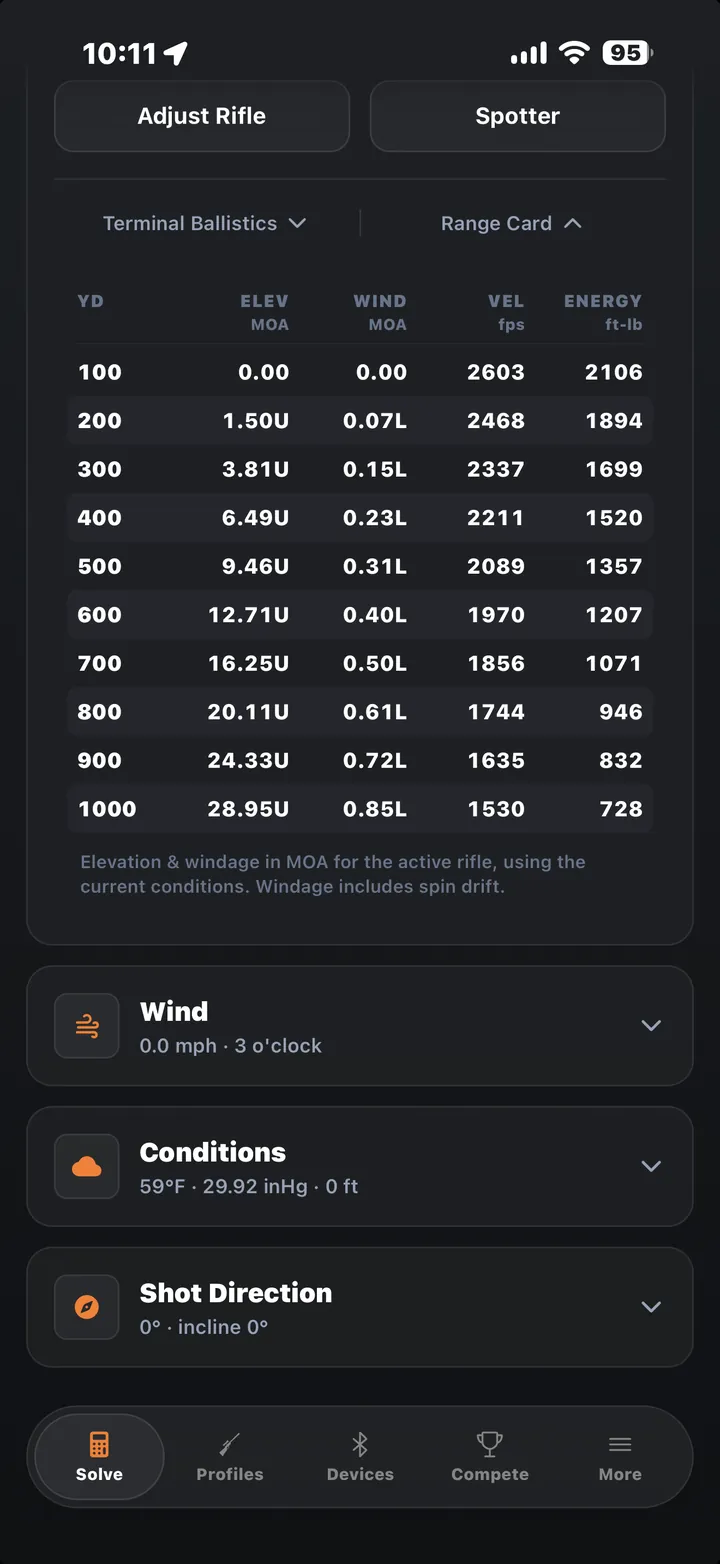
Elevation, windage, spin drift and Coriolis are shown as separate lines, so you know exactly what you are holding for and why.
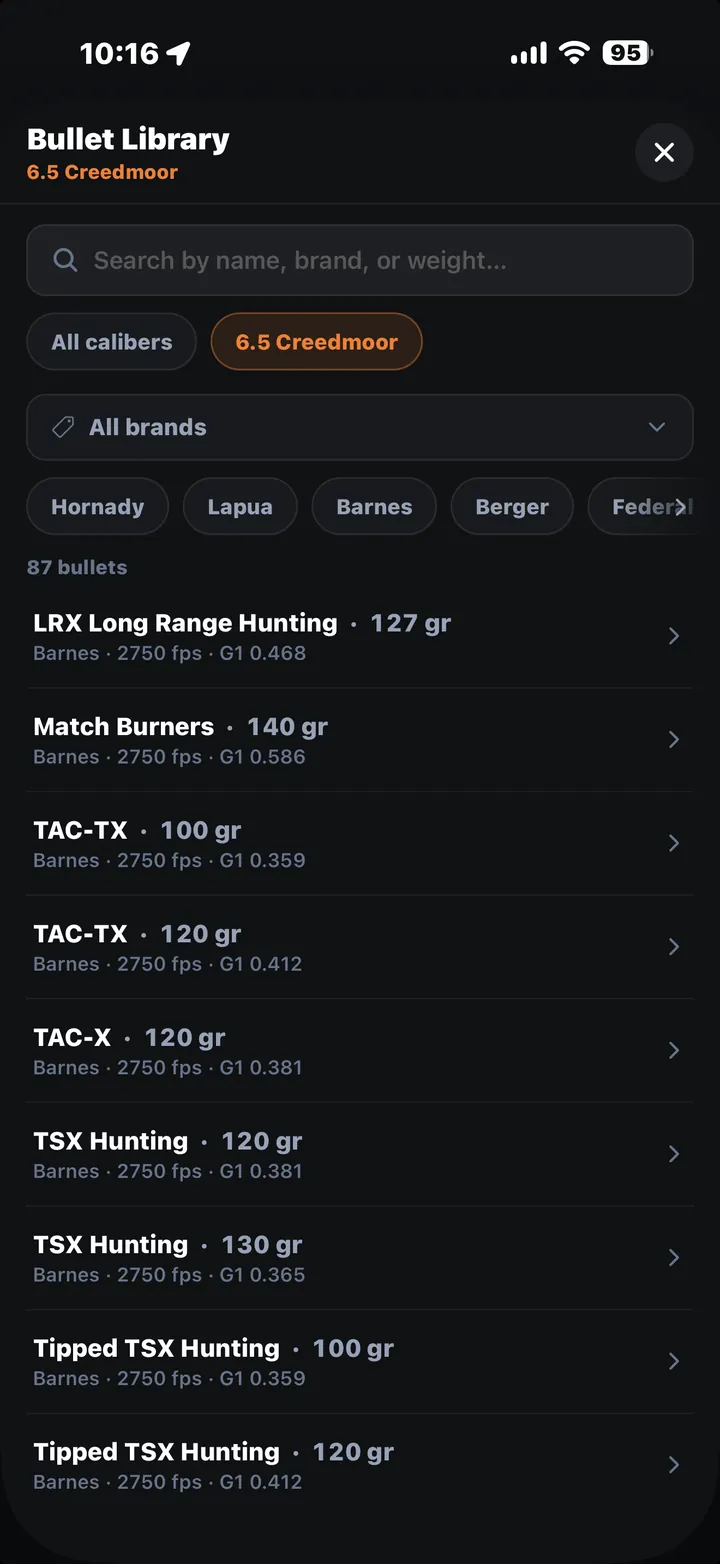
935 bullets, not one brand
399 factory loads from 21 manufacturers plus 536 bullets, or add your own. Switch loads without leaving the app.
Stage cards for match day
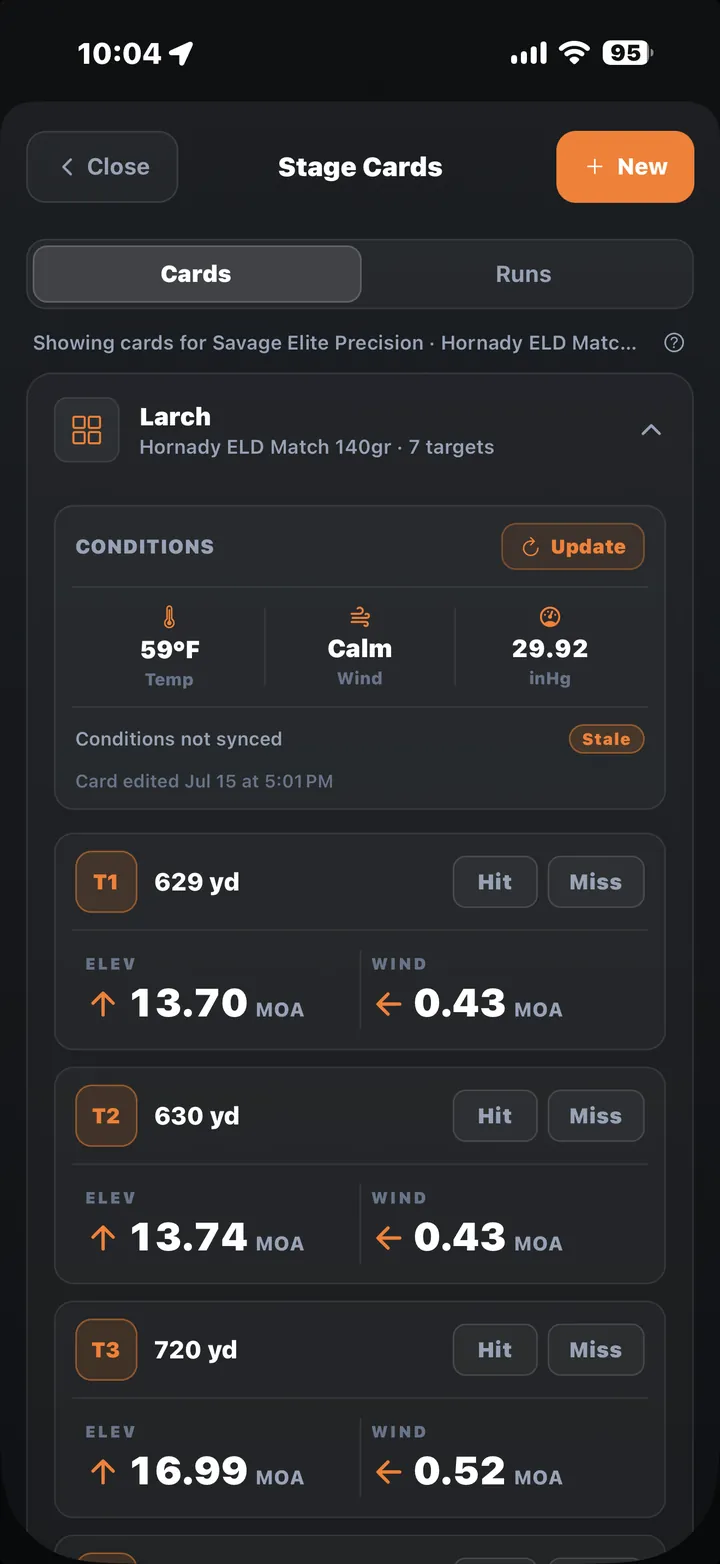
Build every target on a stage with its own solve, run it on the clock, and review hits and misses after.
Best Free Ballistic Calculator App: Quick Guide
Searching for a free ballistic calculator app? Here is the short version by platform:
- iPhone, iPad and Android: Atlas Ballistics is free to download on the App Store and Google Play with an optional Pro subscription, and works fully offline.
- Hornady ammo: the Hornady 4DOF app is free and strongest with Hornady bullets.
- Desk-only checks: JBM is a free web calculator, but has no app or offline use.
The full ranking and methodology follow below. For a side-by-side of devices like Kestrel, see best ballistic calculator.
How We Ranked These Apps (Methodology)
Rankings were built around the criteria that determine whether an app produces reliable, field-verified firing solutions, not interface polish or brand recognition.
Solver engine is the foundation. A point-mass solver treats the bullet as a particle subject to drag, gravity, wind, Coriolis, and spin drift. A 4DOF solver adds gyroscopic stability modeling and an axial form factor, which improves accuracy at transonic speeds and for bullets with high aspect ratios. Both are legitimate; what matters is whether the implementation is correct.
Drag model support determines how accurately the solver represents real bullet behavior. G1 is the standard flat-base reference projectile. G7 is the long boat-tail reference and fits most modern match and hunting bullets far more accurately above 1,000 yards. Custom Drag Model (CDM) curves, measured by Doppler radar against a specific bullet, are the most accurate option when available.
Atmospheric correction method matters because ballistic coefficient is atmosphere-dependent. Apps should use ICAO standard atmosphere as the reference and correct for actual density altitude, not just temperature or altitude in isolation.
Truing methods, muzzle velocity (MV) truing and BC truing, determine whether a shooter can anchor a solution to real-world observation. Apps that support both, and guide the user through correct sequencing, are meaningfully more useful at long range.
Wind calculation sophistication covers full-value vs. angled wind inputs and whether the app supports multiple simultaneous wind nodes at different distances.
Hardware integrations (Kestrel Bluetooth, rangefinder inputs, Hornady 4DOF API) affect how quickly and accurately environmental data enters the solver.
Platform is noted across iOS, Android, Mac and web so you know what runs on your kit.
Pricing model is called out honestly, including which apps offer genuinely usable free tiers.
Development cadence, whether the app receives active updates, is a proxy for long-term reliability and bug resolution.
Atlas Ballistics — Full Deep Dive
Solver
Atlas Ballistics uses a point-mass solver with Coriolis and spin-drift corrections applied. Spin drift, the gyroscopic precession of a stabilized bullet away from its spin direction, becomes non-negligible around 600 yards and increases roughly with range squared. A right-hand-twist barrel will push the bullet right; ignoring this at 1,000 yards can mean a miss that looks like a wind-call error. Coriolis effect is smaller in magnitude at practical ranges but becomes meaningful beyond 1,000 yards at mid-latitudes, deflecting the bullet based on latitude, azimuth, and time of flight. Atlas accounts for both so the solver does not require the shooter to mentally compensate.
Drag Model Support
G1, G7, and custom drag curves are all supported. G7 is the correct reference for long, boat-tail, secant-ogive projectiles, the geometry more closely matches the reference projectile, so the BC remains more constant across velocity. G1 BCs are still widely published and supported for compatibility. Custom drag curves allow projectile-specific modeling that reflects actual measured drag at every velocity node, which is particularly valuable through the transonic regime (roughly 1.0–1.3 Mach) where drag rise is steep and G1/G7 approximations diverge from reality.
Truing Workflow
MV truing is the correct first step: shoot at a confirmed distance, compare computed drop to observed impact, and adjust muzzle velocity until they match. Only after MV is independently verified, ideally via a calibrated chronograph, should BC be adjusted to reconcile remaining error at extended range. Atlas enforces this sequence rather than letting users arbitrarily adjust either variable first, which prevents building solutions on compounding assumptions.
Wind Holds
Full-value and angled wind inputs are supported. Multiple simultaneous wind nodes can be entered for different range bands, which matters on courses with terrain-driven wind variation.
Shot Logging and Stage Cards
Shot logging captures environmental conditions, hold data, and observed impacts with timestamps. Stage cards, critical for PRS and NRL competition, are generated from your verified DOPE and formatted for quick reference at the firing line.
Environmental Inputs
Pressure, temperature, humidity, altitude, and shooting angle are all available. For inclined shots, Atlas applies the cosine rule (multiply range by cosine of inclination angle to get the ballistic range) rather than the rifleman's rule approximation. The cosine rule is mathematically correct; the rifleman's rule is a close approximation that degrades at steep angles above roughly 30 degrees.
Applied Ballistics Mobile — Deep Dive
Applied Ballistics Mobile is Bryan Litz's commercial solver and represents one of the most technically rigorous options available to civilian shooters. The AB solver is respected specifically because Litz's team has Doppler-radar-measured a large library of projectiles, meaning the CDM curves and G7 BCs in the library are independently verified rather than manufacturer-reported.
Solver and Drag Models
AB Mobile supports point-mass solving with a full CDM library and also offers 4DOF solving for supported projectiles. The CDM library is the primary differentiator: if you are shooting a bullet with a published AB CDM curve, your drag model is more accurate than anything a G1 or G7 BC can provide, particularly through transonic speeds.
Kestrel Integration
Applied Ballistics is deeply integrated into Kestrel's AB-edition weather meters. If you already own a Kestrel with AB onboard, the ecosystem works well and the data pipeline from atmosphere to firing solution is tight. The companion app extends that workflow to a phone interface.
Platform and Price
AB Mobile runs on both iOS and Android, which is a meaningful advantage for Android users looking for a full-featured solver with a verified BC library. The price point is in the premium tier.
Where Atlas Ballistics Differentiates
Atlas competes on UI/UX, the stage card workflow and truing sequencing are purpose-built for competition shooting in a way that AB Mobile's more general-purpose interface is not. For a PRS shooter who needs to build, verify, and call up DOPE cards quickly at a stage, Atlas is the more focused tool. For a shooter whose primary concern is projectile library depth and CDM accuracy, AB Mobile's library is the current benchmark.
Both apps are honest answers to 'best ballistic calculator app' depending on the use case. Neither is wrong.
Hornady 4DOF App — Deep Dive
The Hornady 4DOF app is the strongest argument for a free ballistic calculator app, and understanding why requires understanding what 4DOF actually means.
What 4DOF Means
A standard point-mass solver models three translational degrees of freedom: x, y, and z movement through space. A four-degree-of-freedom solver adds rotation about the bullet's longitudinal axis, which means it can model gyroscopic stability, the bullet's dynamic response to aerodynamic forces, and the resulting lift-induced drift. Instead of using a BC (which is a drag approximation), a 4DOF solver uses an axial form factor derived from the bullet's physical geometry and measured stability characteristics. This is more physically complete, particularly at transonic speeds where a G1 or G7 BC approximation can accumulate significant error.
The Limitation
The Hornady 4DOF app is limited to Hornady's own projectile library. If you are not shooting Hornady bullets, the app cannot generate a valid firing solution for your load. This is the core tradeoff: the solver physics are excellent, but the ammunition scope is narrow. It is a legitimate 'best free ballistic calculator' answer for Hornady bullet users.
Compared to Atlas Ballistics
Atlas supports user-defined projectile data across G1, G7, and custom drag curves, which covers the full range of bullets a precision shooter might use. Hornady 4DOF does not offer shot logging, stage card generation, or a truing workflow, it produces a firing solution but does not build the verification infrastructure around it. For a PRS competitor or long-range hunter using non-Hornady projectiles, that gap is material.
For a shooter zeroing a Hornady ELD-X hunting load before a season, the free Hornady app is a technically sound, cost-free option.
Best Free Ballistic Calculator Options (Apps and Online)
'Free' in the ballistics calculator space means different things: a permanently free app, a free tier with locked premium features, or a web-based calculator with no install required.
Free App Options
- Hornady 4DOF (iOS and Android): Free, 4DOF solver, Hornady projectiles only. The strongest free solver available if your bullets are in their library.
- Ballistic AE free tier (iOS and Android): Point-mass solver, G1/G7 support, limited to a small number of saved profiles. Functional for basic use inside moderate ranges.
- iSnipe (iOS, free tier): Entry-level point-mass solver. Adequate for straightforward range sessions inside 500 yards.
Online Calculators
- JBM Ballistics (web, free): A long-standing, respected point-mass solver used by many experienced shooters as a cross-check tool. Supports G1, G7, and custom inputs. No registration required.
- Hornady online calculator (web, free): Browser-based version of their solver, limited to Hornady data.
Tradeoffs of Online vs. Native App
Online calculators require connectivity, they do not function in the field without cell service. They do not integrate with Kestrel or rangefinder hardware, do not log shots, and cannot generate stage cards. For a pre-range planning session or a sanity check against another solver, they are useful. For field use, a native app is the correct tool.
Atlas Ballistics and Pricing
Atlas Ballistics is free to download, with an optional Pro subscription ($5.99/mo). Pro funds active development and unlocks the full feature set, truing workflow, shot logging, stage cards, hardware integration, none of which exist in any free tier of any competitor. If those features do not match your current shooting, one of the free options above is a legitimate starting point.
iOS and Android Support
Atlas Ballistics runs natively on both iPhone/iPad and Android, with your rifles, loads and shot logs syncing across devices.
How to Choose the Right Ballistic Calculator App for Your Shooting
PRS or NRL competitor
You need fast hold lookup, stage cards you can generate from verified DOPE, and a truing workflow you can trust under time pressure. Atlas Ballistics is purpose-built for this use case. No mobile competitor currently matches the stage card workflow or enforces truing sequencing the same way.
Long-range hunter
You need offline capability, angle compensation, reliable environment inputs, and a projectile library that covers hunting bullets. Atlas Ballistics or Applied Ballistics Mobile are both sound choices. If you shoot Hornady ELD-X or ELD-M projectiles, the free Hornady 4DOF app is worth evaluating as a cost-zero option before buying.
Budget or beginner shooter inside 600 yards
At this range with standard loads, a G1 or G7 point-mass solver is sufficient. Spin drift and Coriolis are small enough to ignore. JBM Ballistics online or the Hornady 4DOF app (if shooting Hornady bullets) give you technically sound solutions without spending anything. Ballistic AE's free tier covers the basics on both iOS and Android.
Android user
Atlas Ballistics is available on Android via Google Play with the full solver, stage cards, shot log, and truing workflow. Hornady 4DOF and Applied Ballistics Mobile also run on Android.
Military or law enforcement with Horus reticles
TRASOL is built for Horus reticle integration and is the standard recommendation in that context. Horus CATS is the alternative. Neither Atlas nor AB Mobile replicates that specific reticle-hold workflow as cleanly.
Do not select an app based on UI screenshots. Select based on which solver handles your projectile accurately, which truing method fits your verification process, and which feature set matches your actual shooting discipline.
Need a quick answer right in your browser before heading to the range? Run your load through our free ballistic drop calculator, check downrange foot-pounds in the bullet energy calculator, convert turret clicks in the MOA to MIL calculator, or check barrel twist and SD in the bullet stability and sectional density calculator.
Your Dope Is Only as Good as the Work You Put Into Truing It
Every ballistic calculator app gives you a number. Atlas Ballistics gives you a verified, trued firing solution backed by a shot log that proves it, and stage cards you can pull up at the firing line without fumbling through menus. The truing workflow enforces correct sequencing so you are not building a 1,000-yard solution on a bad muzzle velocity assumption. Download Atlas Ballistics free on the App Store or Google Play and run your first verified solution today.
Frequently asked questions
Keep reading
Muzzleloader & Airgun Ballistic Calculator
Best Rangefinders with Ballistic Calculator: 2026 Buyer's Guide
Best Ballistic Calculator in 2026: Apps, Software & Handheld Devices Compared
Berger & Vortex Ballistic Calculator – The Atlas Alternative for Precision Shooters
Ammo Brand Ballistic Calculators Compared: Federal, Remington, Winchester & More
Free Ballistic Calculator: Bullet Drop, Wind Holds & Ballistic Tables
More free ballistic calculators
All free, all in the browser, no download needed.
Ballistic Calculator
Full trajectory table with drop, drift, velocity and energy.
Ballistic Coefficient Calculator & Chart
Estimate effective G1/G7 BC, inspect form factor, and browse bullet reference values.
Muzzleloader & Airgun Calculator
G1/G7 trajectory estimates with specialty-projectile model limitations.
Bullet Energy Calculator
Kinetic energy downrange, against hunting thresholds.
MOA to MIL Calculator
Convert MOA, MIL and inches, and get your scope clicks.
Twist Rate Calculator
Miller stability factor and the twist your bullet needs.
Bullet Stability Calculator
Sg at your velocity, plus sectional density.
Recoil Calculator & Chart
Free recoil in foot-pounds and side-by-side cartridge recoil chart.
Angle Shot Calculator
Uphill and downhill range correction with the cosine rule.
Grains to Grams
Convert bullet and powder weights both ways.
Density Altitude Calculator
Temperature, pressure and humidity turned into density altitude.
MPBR & Optimal Zero
Find a suggested zero and point-blank range for your target-zone size.
Zero Calculator
Sight in at 25 yd for a 100 yd zero, and compare 36, 50 and 100 yd zeros.