Berger & Vortex Ballistic Calculator – The Atlas Alternative for Precision Shooters
Berger bullets ballistic calculator app compared with Vortex LRBC and Atlas. Use Berger G7 BCs offline, with truing and spin drift. Free on iPhone and Android.
- Berger calculator — best if you shoot Berger bullets and want their Doppler-measured G7 BCs. Web-only, no truing, no offline use.
- Vortex LRBC — best if you run Vortex glass and want a free app for hunting inside ~600 yd. Defaults to G1, no truing, no spin drift or Coriolis.
- Atlas Ballistics — best if you shoot past 600 yd, compete, or hunt without signal. Any bullet or optic, G7 + drag factor tuning, live truing, spin drift, Coriolis, stage cards, fully offline.
Bottom line: Berger and Vortex are good free starting points for their own products. If you need a solution you can true and trust at distance, Atlas is the upgrade.
Feature-by-feature comparison
| Feature | Berger | Vortex LRBC | Atlas |
|---|---|---|---|
| Ballistic model | |||
| Drag model | G7 (Doppler) | G1 default, G7 | G1, G7 + drag factor tuning |
| Bullet library | Berger only | Multi-brand, limited | 935 loads & bullets, any brand |
| Spin drift | |||
| Coriolis | |||
| Aerodynamic jump | |||
| In the field | |||
| Truing to your rifle | MV truing (Pro) | ||
| Works offline | |||
| Shot logging | |||
| Stage cards / DOPE export | yes (Pro) | ||
| Access | |||
| Platform | Web | iOS, Android | iOS, Android |
| Optic lock-in | None | Vortex-optimized | Any optic |
| Cost | Free | Free | Free, Pro $5.99/mo |
Capability coverage
Share of the 5 long-range capabilities in the table above that each tool supports.
Which one should you pick?
Berger
Choose it if: you shoot Berger bullets and want a quick solution in a browser.
- Doppler-measured G7 BCs
- Free, no sign-up
- Berger bullets only
- No truing or offline use
Vortex LRBC
Choose it if: you run Vortex glass and hunt inside about 600 yards.
- Free phone app
- Output matches Vortex turrets and reticles
- G1 by default
- No spin drift, Coriolis or truing
Atlas
Choose it if: you shoot past 600 yards, compete, or hunt without signal.
- 935 loads and bullets from any brand, plus your own
- Spin drift, Coriolis and aero jump built in
- Works offline, with stage cards and a shot log
- Requires internet only for live weather and AI box scanner
- Truing, stage cards and shots past 300 yd need Pro
What you get that the others don't
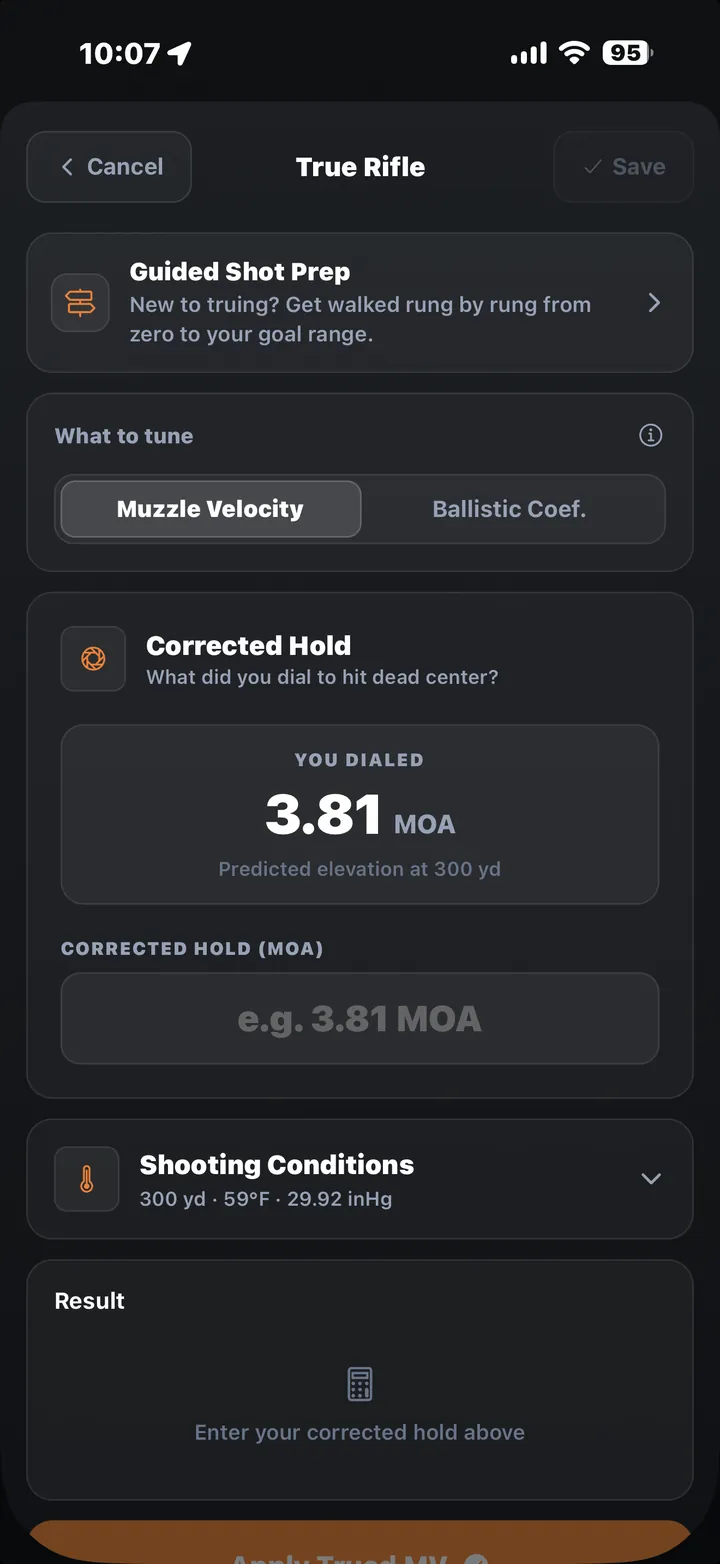
True your rifle in minutes
Enter one real impact at distance and Atlas solves your true muzzle velocity so the whole drop chart matches your rifle. Neither Berger nor Vortex can true a solution.
Spin drift and Coriolis, broken out
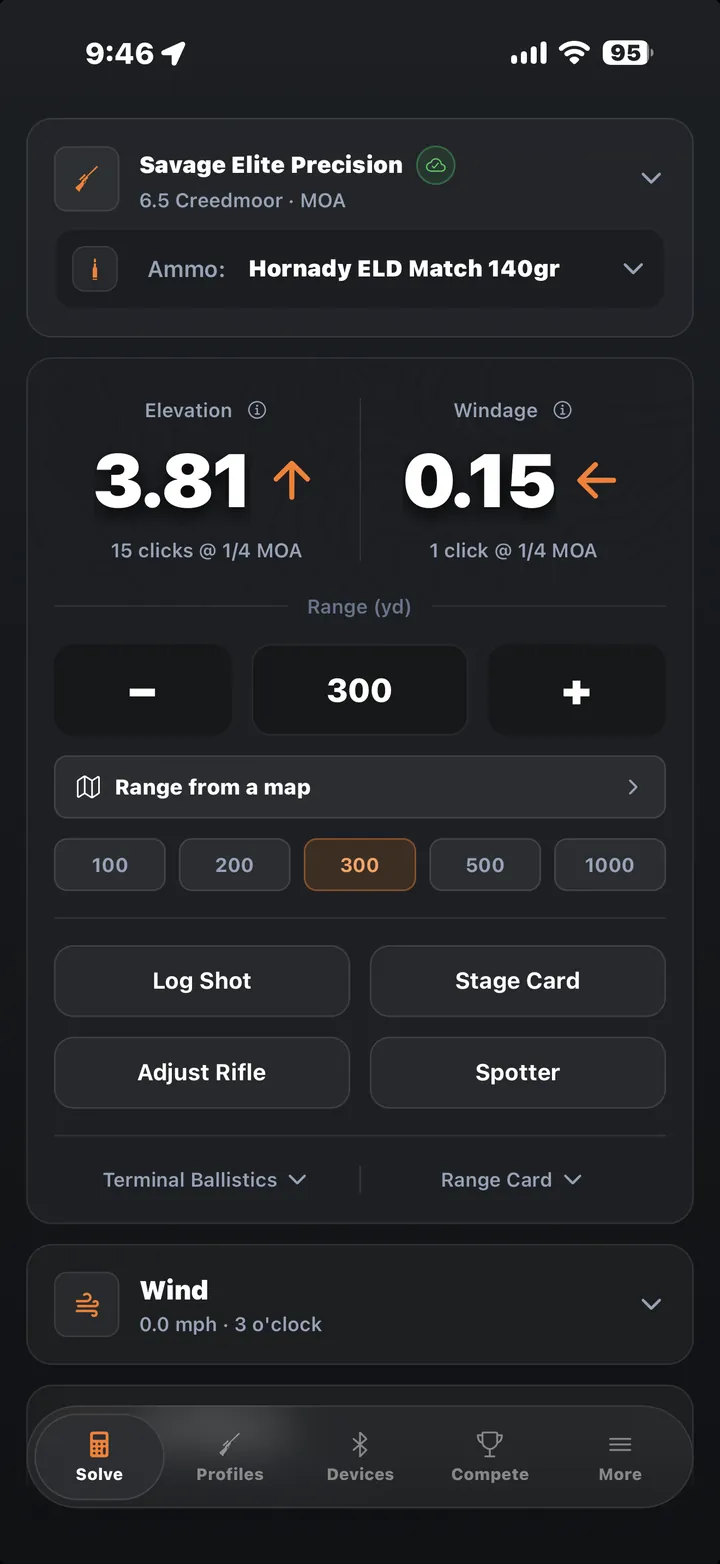
At 1,000 yards spin drift alone can move impact several inches. Atlas shows it and Coriolis as separate lines so you know exactly what you are holding for.
935 bullets, not one brand
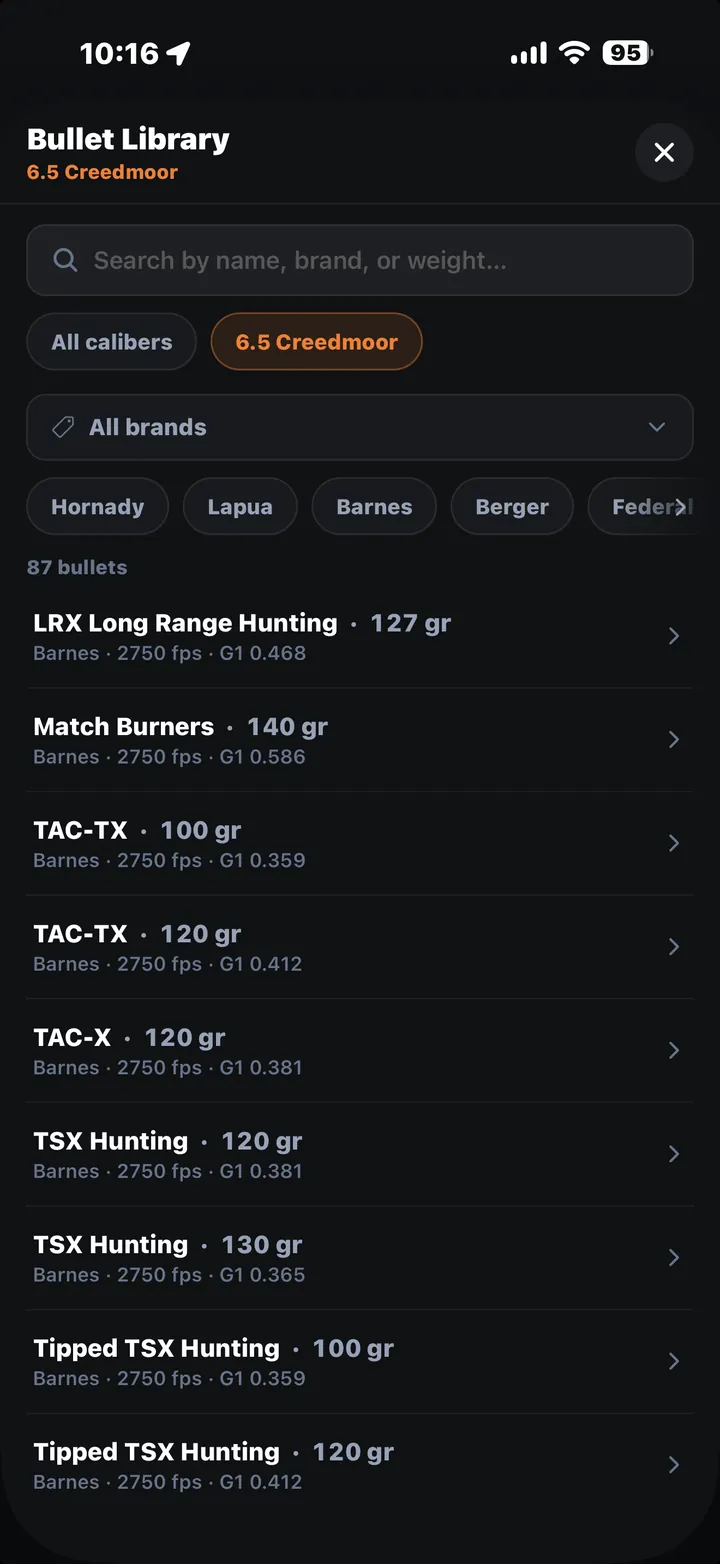
399 factory loads from 21 manufacturers plus 536 bullets, or add your own. Switch loads without leaving the app.
Stage cards for match day
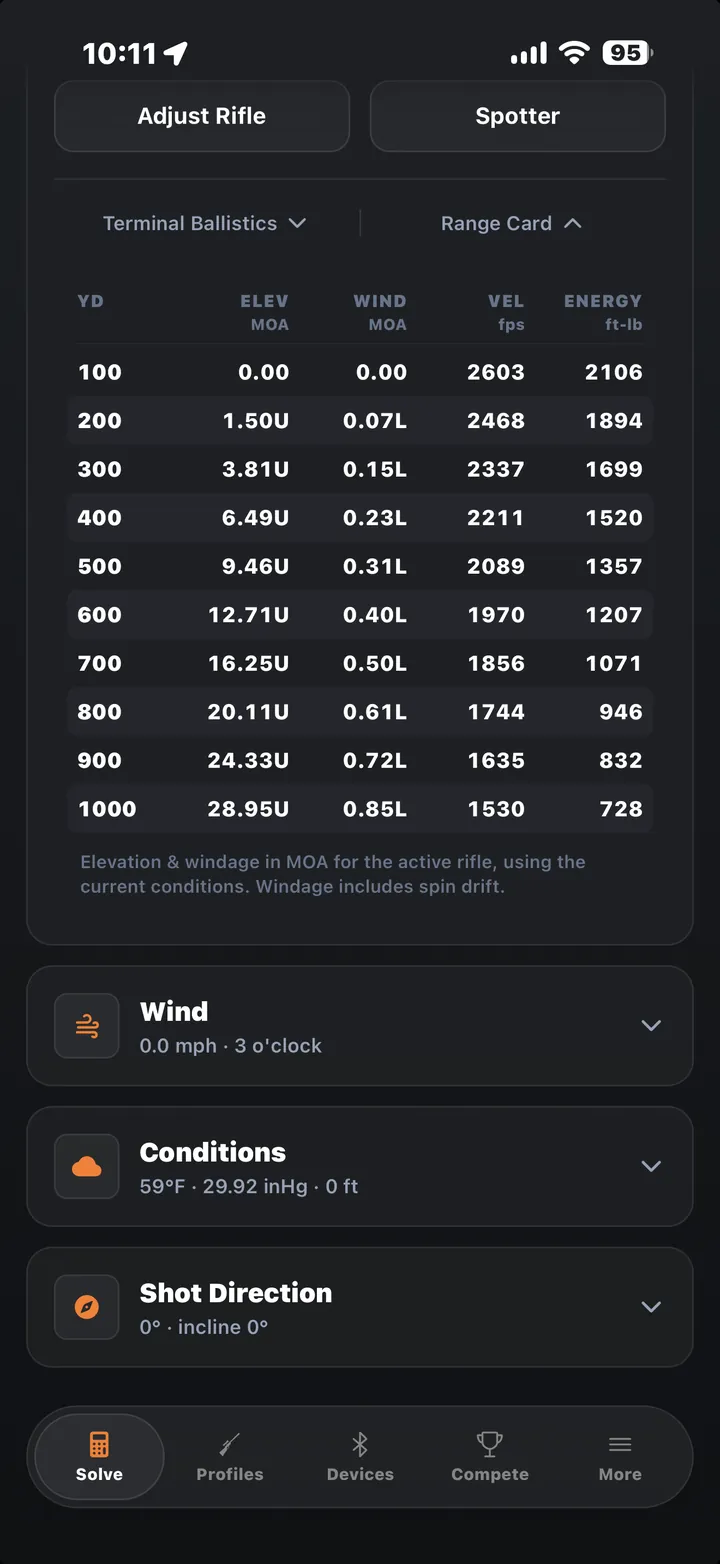
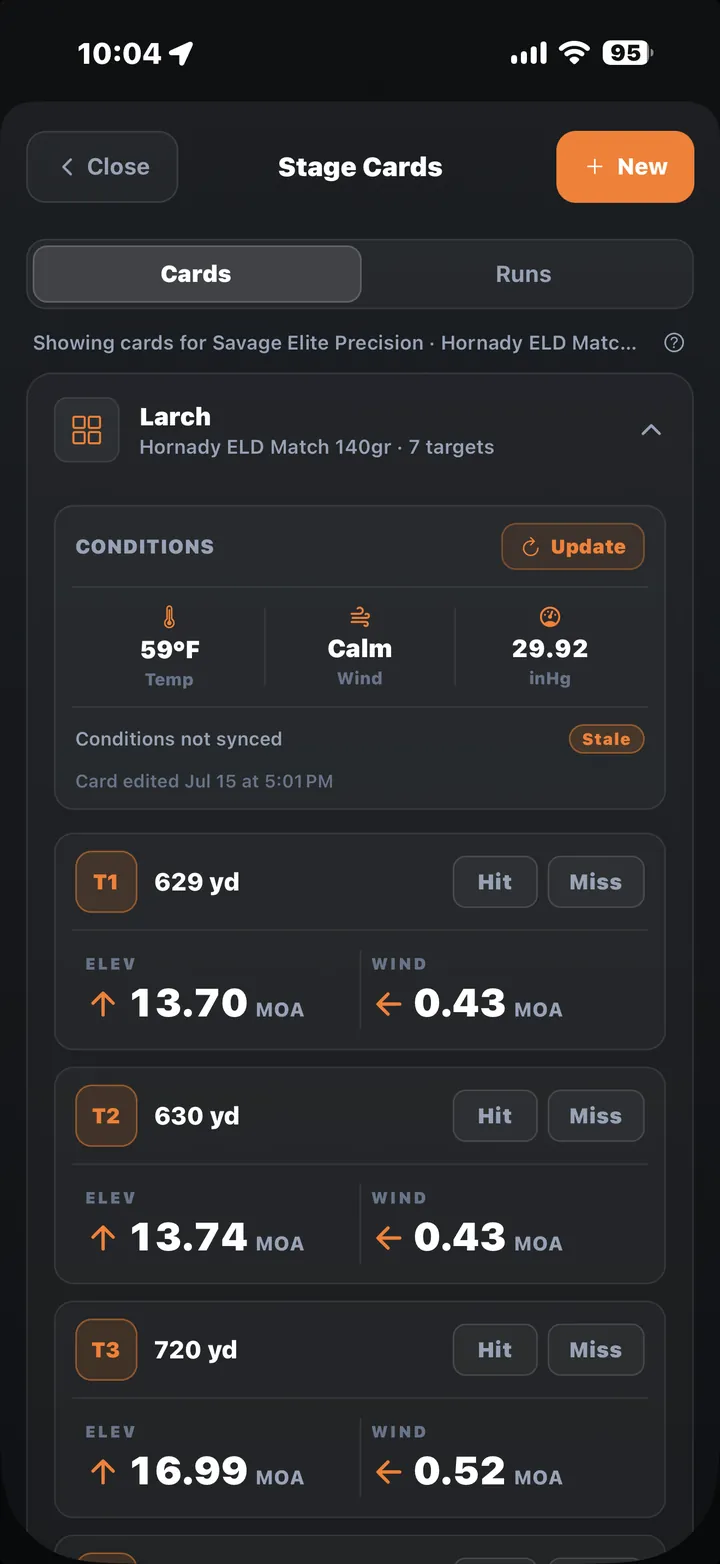
Build every target on a stage with its own solve, run it on the clock, and review hits and misses after.
Looking for the Berger Ballistic Calculator?
Berger's own calculator is a web tool built around Berger bullets and their Doppler-measured G7 ballistic coefficients. It is a solid starting point if you shoot Berger and want a quick number at a desk.
What it does not do is live in your pocket at the range: it needs a connection and does not true to your real impacts. If you want to keep using Berger's published G7 BCs but solve on your phone, enter the bullet weight, G7 BC and muzzle velocity from Berger's data in Atlas, select G7, and you get the same bullet data with offline solving, truing, spin drift and Coriolis. Atlas is free to download with an optional Pro subscription.
What Is the Berger Ballistic Calculator — and What It Does Well
Berger Bullets hosts a free web-based ballistic calculator on their site, built primarily to support their own projectile lineup. It earns its reputation because the underlying data is serious: Bryan Litz and the Berger team measured G7 BCs using Doppler radar across their hybrid, VLD, target, and hunting bullet lines, producing coefficients that are among the most rigorously verified in the industry. For a shooter already running Berger projectiles, it provides a credible first-round firing solution without requiring any third-party app.
What it does well:
- G7 BCs derived from Doppler radar testing, not manufacturer estimates or reverse-engineered catalog numbers
- Covers roughly 200+ Berger projectiles across hybrid, VLD, fullbore, and hunting configurations
- Fast, no-account web access for a quick field reference
- Respected by the PRS and F-Class communities for accuracy within its scope
Where it stops:
- Web-only, no offline use; useless at altitude without cell service
- No truing workflow: if your actual drops don't match the solution, you have no in-tool mechanism to back-calculate corrected MV or BC
- No Coriolis correction, no spin drift modeling, no aerodynamic jump
- No shot logging, no stage card export
- Limited to Berger projectiles, if you handload with Hornady A-Tip, Sierra MatchKing, Lapua Scenar, or Nosler RDF bullets, the tool is not useful
The tone here is not criticism for its own sake. The people behind the Berger ballistic calculator understand exterior ballistics better than most. The tool reflects a deliberate scope: help Berger customers get on paper. It does that well. It is not designed to be a complete firing solution platform, and it does not pretend to be.
What Is the Vortex Ballistic Calculator (LRBC) — and What It Does Well
Vortex offers two related tools: a web-based ballistic calculator and the Vortex LR Ballistic Calculator (LRBC), available as a free iOS and Android app. Both are designed to pair with Vortex optics, the Viper PST, Razor HD Gen II, Strike Eagle, and the rest of the lineup, and output firing solutions in the turret units matching those specific scopes (MOA or MRAD depending on model).
The vortex long range ballistic calculator targets hunters and shooters new to long-range who want a simple interface tied to the glass already on their rifle. For that use case it delivers: quick setup, clean output, no cost.
What it does well:
- Free and accessible; low barrier to entry
- Outputs in the click values of Vortex turrets, which reduces unit-conversion errors for less experienced shooters
- Mobile app format makes it more practical than a web-only tool in the field
- Vortex's Applied Ballistics partnership on select products (Razor AMG, certain Vortex RS systems) does upgrade solver accuracy significantly for users who go that route, though the AB ecosystem is a separate cost
Where the Vortex ballistic calculator app stops:
- Defaults to G1 drag modeling. G1 is referenced to a flat-based 2-caliber-ogive projectile from the 19th century; long, high-BC bullets like the Berger 140gr Hybrid, Sierra 183gr MatchKing, or Lapua 185gr Scenar deviate meaningfully from the G1 curve beyond 600 yards, particularly at transonic transitions (~1,340 fps). G7 or CDM drag functions are more appropriate for these projectiles
- No Coriolis correction, no spin drift, no aerodynamic jump modeling
- No truing workflow
- No shot logging, no stage card or DOPE card export
- Optimized for Vortex optics, shooters running Nightforce, Kahles, S&B, or Tangent Theta scopes are working around the tool's assumptions rather than with them
The best vortex ballistic calculator experience is still a limited one relative to what a complete firing solution workflow requires at 800-plus yards.
Why Precision Rifle Shooters Need More Than a Brand Calculator
Three technical gaps separate a basic ballistic calculator from a tool you can trust on a cold-bore first-round hit at distance.
1. Truing
A firing solution is only as good as your confirmed muzzle velocity and BC. The MV printed on a box of ammunition or measured on a cheap chronograph carries real uncertainty. Published BCs, even Doppler-measured ones, are population averages; your specific lot of bullets, your barrel, your chamber, your altitude on that day will produce a slightly different result. Truing is the process of adjusting MV or BC input until your calculated drop matches your observed impacts at known distance. It is not optional for serious long-range work; it is the step that converts a theoretical solution into a verified one. Neither the Berger nor the Vortex tools support this workflow. Atlas's live truing function lets you input observed point of impact at distance, back-calculate the corrected MV or BC, and update your solution in the field before your next string.
2. Spin Drift and Coriolis
Spin drift is a function of bullet gyroscopic stability, a right-hand-twist barrel produces rightward spin drift. At 1,000 yards, a 140gr projectile fired from a 1:10-twist barrel at approximately 2,700 fps will experience roughly 3–5 inches of spin drift depending on bullet length and gyroscopic stability factor. That is 0.3–0.5 MOA, a full miss on a small PRS target. Coriolis effect at 1,000 yards varies by shooter latitude and firing azimuth but can exceed 1 MOA in worst-case geometries at extreme range. Both effects are directional, consistent, and predictable, which means they are correctible with the right tool. Ignoring both at 800 yards and beyond is leaving guaranteed error in your solution.
3. Transonic Drag and G1 vs G7
Berger Hybrids and similar VLD-profile bullets are engineered to remain stable through the transonic zone (approximately 1,340 fps), but the drag curve steepens sharply in that region. G1 drag functions, modeled on a blunt, flat-based reference projectile, systematically overestimate retained velocity for long, high-BC bullets at transonic speeds, producing optimistic drop predictions at extended range. G7 drag functions, referenced to a long-range boat-tail projectile, track the actual flight of modern match bullets far more accurately. CDM (custom drag model) data, as advocated by Bryan Litz and Applied Ballistics, goes further still by using bullet-specific measured drag curves. Atlas uses Litz-validated drag data across its library, giving you the most accurate drag model available for the bullets you are actually shooting.
How Atlas Ballistics Works With Berger Bullets and Vortex Optics
Atlas is not a replacement for Berger bullets or Vortex glass. It is the firing solution layer that connects your equipment to accurate, workflow-complete ballistic data. Here is how the integration looks in practice.
Step 1, Build your rifle profile Select any Berger projectile from the Atlas library. Litz G7 BC data is pre-loaded for the full Berger lineup, 105gr Hybrid, 140gr Hybrid, 155.5gr Fullbore, 185gr Juggernaut, 230gr Hybrid, and the rest. Enter your barrel's twist rate and your sight height above bore. These inputs directly affect spin drift calculation and are required for an accurate solution.
Step 2, Configure your Vortex optic Under scope settings, enter your optic's click value. Vortex covers a wide range: the Viper PST Gen II runs 1/4 MOA or 0.1 MRAD depending on model, the Razor HD Gen II-E uses 0.1 MRAD, the Strike Eagle 1/2 MOA. Atlas lets you set the exact click value so all outputs are displayed in your turret's native units, no mental conversion under time pressure.
Step 3, Generate and true your solution Build your initial firing solution with your environmental conditions. Head to the range. Fire at a known distance, 500 or 600 yards is a practical truing distance for most long-range loads, and note your actual point of impact. Input that observation into Atlas's truing workflow. The app back-calculates the corrected MV or BC and updates your solution across all ranges.
Step 4 — Log shots and export Log each shot with range notes, conditions, point of impact, corrections applied. When you need a stage card for a PRS match or a hunting DOPE card for a specific elevation band, export directly from Atlas.
Atlas supports both MOA-based and MRAD-based optics without preference, the tool works with what is on your rifle, not around it.
Getting Started: Download Atlas and Import Your Berger or Vortex Load
Setup for a shooter who already knows their load data takes under five minutes.
- Download Atlas Ballistics free on the App Store or Google Play, no account creation required to use the free tier
- Create a rifle profile: enter barrel length, twist rate, and sight height above bore
- Select your bullet: choose your Berger projectile from the library, or enter a custom G1/G7 BC and bullet weight for any projectile not in the database
- Set your scope: enter your Vortex optic's click value under scope settings so outputs display in your turret's native units
- Enter environmental conditions: input manually, or allow Atlas to pull live weather data via GPS for your current location
- Run your firing solution: review drop and wind holds in MOA or MRAD, then generate a range card from 100 yards to your target distance in 100-yard increments
- Export your stage card or DOPE card: share as PDF or use within the app on the range
Atlas works fully offline. If you are shooting at altitude in a canyon, in a national forest with no cell coverage, or on a PRS stage where you burned through your data plan, your firing solution is still there, updated with the last GPS weather pull before you lost signal. The free tier requires no subscription and no login. Premium features extend the workflow; the core solver runs without them.
Download Atlas Ballistics — One App for Your Entire Firing Solution Workflow
Berger makes the best bullets. Vortex makes world-class glass. Atlas Ballistics ties everything together with a firing solution your equipment deserves, spin drift, Coriolis, aerodynamic jump, live truing, and stage cards built for iOS and Android. Download free on the App Store or Google Play, no account required, and have a verified firing solution ready before your next range session. The web calculators are useful at a desk; Atlas is what you take to the line.
Frequently asked questions
Keep reading
Muzzleloader & Airgun Ballistic Calculator
Best Rangefinders with Ballistic Calculator: 2026 Buyer's Guide
Best Ballistic Calculator in 2026: Apps, Software & Handheld Devices Compared
Ammo Brand Ballistic Calculators Compared: Federal, Remington, Winchester & More
Best Ballistic Calculator Apps in 2026: An Honest Comparison for Precision Shooters
Free Ballistic Calculator: Bullet Drop, Wind Holds & Ballistic Tables
More free ballistic calculators
All free, all in the browser, no download needed.
Ballistic Calculator
Full trajectory table with drop, drift, velocity and energy.
Ballistic Coefficient Calculator & Chart
Estimate effective G1/G7 BC, inspect form factor, and browse bullet reference values.
Muzzleloader & Airgun Calculator
G1/G7 trajectory estimates with specialty-projectile model limitations.
Bullet Energy Calculator
Kinetic energy downrange, against hunting thresholds.
MOA to MIL Calculator
Convert MOA, MIL and inches, and get your scope clicks.
Twist Rate Calculator
Miller stability factor and the twist your bullet needs.
Bullet Stability Calculator
Sg at your velocity, plus sectional density.
Recoil Calculator & Chart
Free recoil in foot-pounds and side-by-side cartridge recoil chart.
Angle Shot Calculator
Uphill and downhill range correction with the cosine rule.
Grains to Grams
Convert bullet and powder weights both ways.
Density Altitude Calculator
Temperature, pressure and humidity turned into density altitude.
MPBR & Optimal Zero
Find a suggested zero and point-blank range for your target-zone size.
Zero Calculator
Sight in at 25 yd for a 100 yd zero, and compare 36, 50 and 100 yd zeros.